8.2 Giving Feedback
Essential Question: How do you give feedback that actually helps a student improve?
Why Feedback Matters
Feedback is critical to teaching and to learning. But not all feedback is created equal. How you give feedback, when you give it, and how much you give all shape whether it actually lands—or whether it bounces off, overwhelms, or erodes a student’s confidence.
Giving feedback is a skill. Like any skill, it gets better with practice. This lesson covers the principles of effective feedback, a protocol for framing it well, the question of timing, and scenarios showing what works and what doesn’t.
The Teachable Moment
The ideal time to give feedback is the teachable moment—that hard-to-describe, hard-to-see-coming instant when a student is attuned just right to the issue, and your feedback produces an “aha.” Teachable moments can’t be scheduled. They can only be recognized.
To recognize them, the teacher must be listening fully. Not waiting to speak. Not running down a mental checklist of corrections. Actually listening to what this student, right now, is doing—what they’re reaching for, what they’re almost getting, where their attention has landed.
Playing an instrument in public takes courage. Take care to ensure your feedback doesn’t destroy a student’s confidence.
What Good Feedback Looks Like
Good feedback is honest—but not all honesty is good feedback. A teacher can say something true that is nonetheless useless, crushing, or mistimed.
Good feedback:
- Offers encouragement alongside productive suggestions.
- Affirms the student’s experimentation so they can turn their research into understanding.
- Opens the door to curiosity.
- Does not shut down the conversation.
- Acknowledges the performer’s courage in playing in front of you.
- Shows you are listening attentively.
- Offers illuminating, useful insight in the right amount.
The last point matters more than it might seem. A student can only work on so much at a time. Too much feedback is overwhelming and unhelpful. One or two precise observations, well-timed, produce more learning than a long list of corrections.
Meet the Student Where They Are
Giving feedback and instruction in the right sequence is critical to good teaching. The more you teach, the more you realize that some feedback works better depending on where the student is in their development.
Try explaining to a ten-year-old horn player how moving the tongue forward helps with lip trills—while they’re still working on producing a stable tone—and your otherwise excellent teaching will go in one ear and out the other. Give that same explanation to a college-level horn performance student, and the tongue adjustment might produce an aha moment and an immediately improved lip trill.
The information was identical. The readiness wasn’t.
A Protocol: Artist-to-Artist
Sometimes having a protocol helps everyone feel they can safely give and receive feedback. One such protocol, from Minnesota’s Artist-to-Artist, suggests asking yourself three questions before offering feedback:
- What do I notice? (“I notice…”)
- What questions come to mind? (“I wonder…”)
- What did the composer or performer intend to convey in this music or performance?
The first question keeps feedback observational rather than evaluative. The second opens curiosity—in both teacher and student. The third grounds the conversation in the intention behind the performance, which is usually more productive than any purely technical critique.
Feedback in the Form of Questions
Sometimes the most effective feedback isn’t a statement at all—it’s a question. When the student has to do a bit of the work of discovery themselves, the insight sticks.
Compare:
Statement
“Your crescendo started too early.”
Question
“Where do you feel the crescendo really wants to arrive?”
The first tells. The second invites the student to listen and find it themselves. The first might produce compliance; the second produces understanding.
Consider Your Language
The words you choose from the podium or the studio chair matter enormously. A single sharp phrase can undo thirty minutes of careful rapport. A well-chosen metaphor can crack a problem open in seconds. Even the way you phrase feedback can be impactful. Always assume the player is giving their best effort and take care that your feedback doesn’t imply otherwise.
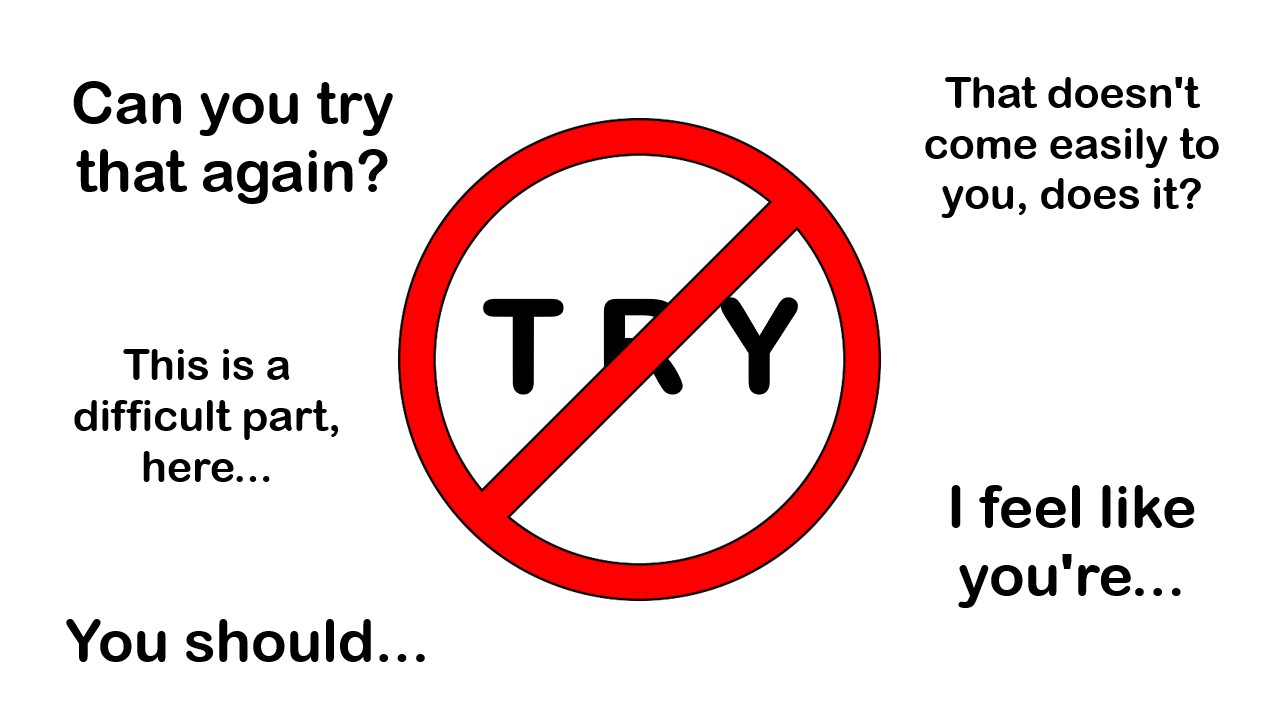
Do or Do Not: A Lesson in Language
Timing: Immediate vs. Delayed Feedback
One of the less obvious questions in teaching is when feedback should arrive. Immediate feedback feels efficient—the problem is right there, and so is the correction. But research on learning shows that immediate feedback often creates dependency on the feedback itself rather than on the student’s own judgment.
Consider two students working on intonation.
Scenario 1: Immediate Feedback
A student places a tuner on the stand and plays through a passage, watching the tuner for each note. They adjust in real time to get the smiley face on every pitch.
Scenario 2: Delayed Feedback
A student records themselves playing through the passage. They listen back—with their ears first, then with a tuner—and note which pitches were out of tune. They return to the passage, play it again with the intention of placing those specific notes in tune, and record again. They continue until each note arrives in tune on the attack, without adjustment.
Which Creates Better Learning?
In Scenario 1, the student feels productive because every note ends up in tune. But what they’re really practicing is adjusting—a useful skill, but not the same as playing in tune. The tuner has replaced their ear.
In Scenario 2, the student is practicing the far more transferable skill of hearing pitch, diagnosing their own playing, and internalizing the correction. The feedback arrives later—but it lands on the ear, not the eyes, and the student learns to play better in tune with themselves.
More Scenarios: Effective vs. Ineffective Feedback
Scenario 3: Specific vs. Vague
A clarinet student plays a staccato passage that sounds stiff and disconnected.
Ineffective: “Your articulation needs work. It’s too heavy.”
Effective: “I notice the tongue is stopping each note as well as starting it. What happens if you let the air keep flowing between notes and only use the tongue to begin each one?”
The first points at a problem without offering a way in. The second names a specific mechanism and invites experimentation.
Scenario 4: The Right Amount, at the Right Time
A trumpet student runs through a Baroque sonata for the first time. They play bravely, make several interpretive choices, miss a few notes, and look up expectantly.
Ineffective: “The tempo was uneven, the high A was flat, the dotted rhythms weren’t crisp, your tone got thin in the second half, and you rushed the ritardando. Let’s go again.”
Effective: “Thank you for that—it took real courage to commit like that on a first read. The one thing I want to focus on for next time is the shape of the dotted rhythms. Let’s listen together to what they’re doing now and decide where we want them to go.”
The first is accurate but crushing; the student will remember the feeling of being buried more than any specific correction. The second acknowledges courage, picks a single priority, and invites the student into the diagnostic process.
Scenario 5: Statement vs. Question
An oboe student plays a long lyrical phrase, but the shape is flat—no arrival, no release.
Ineffective: “You need to shape that phrase. Make it go somewhere.”
Effective: “If this phrase were a sentence, which word would be the most important one? Where would your voice lift, and where would it settle?”
The first is a correction the student doesn’t know how to act on. The second gives them a framework—sentence, word stress—they already understand from speech, and lets them discover the musical answer themselves.
Key Takeaways
- Feedback is a skill—practice it.
- The teachable moment rewards deep listening, not waiting to speak.
- Good feedback is honest, specific, encouraging, and doled out in doses the student can absorb.
- Match your feedback to the student’s readiness—the same correction can be gold at one level and noise at another.
- Protocols like Artist-to-Artist’s “I notice / I wonder / What was intended?” keep feedback observational and curious.
- Framing feedback as a question often produces more learning than framing it as a statement.
- Delayed feedback builds independent judgment; immediate feedback can create dependency.
For Next Class
You will take turns as teacher, student, and observer.
- The teacher will lead the student through a warm-up, long tone, articulation, intonation, or vibrato exercise.
- The teacher will then listen to an excerpt the student is working on and share feedback.
- The observer will write down their observations—skills used effectively, noticed opportunities for improvement.
Once everyone has had a chance to be at least teacher and observer, we will share feedback and observations with each other—another opportunity to practice giving feedback!