8.3 Transpositions
Essential Question: How do you read a transposing score, and how do you convert parts between instruments in different keys?
Why Different Instruments Are in Different Keys
Have you ever wondered why a trumpet is “in B-flat” or a horn is “in F”? Before valves were invented, brass instruments could only play the notes of a single harmonic series. To play in different keys, players swapped out crooks—extra lengths of tubing that changed the fundamental pitch of the instrument. A horn with an F crook played the F harmonic series; switch to a D crook and you had the D harmonic series. The written part stayed the same but sounded at a different pitch depending on which crook was inserted. This is why horn players transpose more than anyone else—the tradition of writing for horns “in” various keys dates back to this crook system.
Woodwind instruments use transposing conventions for a different practical reason: it allows players to switch between instruments of different sizes—soprano, alto, tenor, bass—without relearning fingerings. A clarinetist who picks up a B-flat clarinet, an A clarinet, or an E-flat clarinet uses the same fingering patterns for the same written notes, even though each instrument produces different concert pitches.
The name of a transposing instrument tells you what concert pitch sounds when the player reads a written C. A “Clarinet in B-flat” sounds B-flat when it plays a written C. A “Horn in F” sounds F when it plays a written C.
Why Teachers Must Transpose
Learning to transpose on your instrument becomes second nature for horn and trumpet players. But all teachers must be able to transpose parts on a score in order to read what the chord is and speak to the individual players in their key. Learning how to transpose a part from one instrument to another is also very helpful for gigging and for ensembles with an atypical group of instruments.
Table of Wind Band Instruments and Transpositions
This reference chart lists every standard wind and percussion instrument and its transposition. Nontransposing instruments are marked NT.
Reading Different Clefs
Instruments also read in different clefs depending on their range. There are four main clefs you will encounter in wind and brass music:
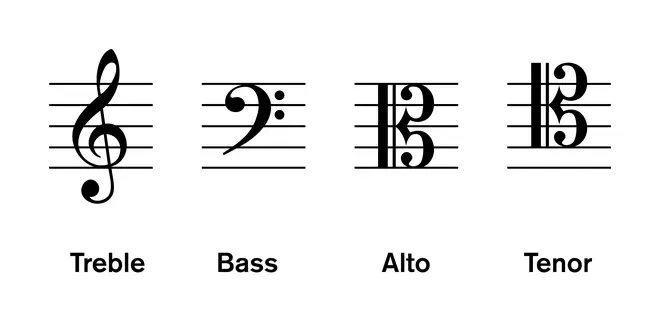
- Treble Clef (G Clef): The curl of the clef wraps around the second line, identifying it as G. Staff lines bottom to top: E – G – B – D – F. Used by flute, oboe, clarinet, saxophone, trumpet, and horn.
- Bass Clef (F Clef): The two dots sit on either side of the fourth line, identifying it as F. Staff lines bottom to top: G – B – D – F – A. Used by trombone, tuba, euphonium, and bassoon.
- Alto Clef (C Clef): The clef symbol points to the third (middle) line, identifying it as middle C. Staff lines bottom to top: F – A – C – E – G. Used primarily by viola; occasionally appears in trombone and English horn parts.
- Tenor Clef (C Clef): The same C clef symbol shifted so that it points to the fourth line as middle C. Staff lines bottom to top: G – B – D – F – A. Used by bassoon, cello, and trombone in their upper registers.
Transposition Gym — Interactive Quiz
Practice transposing between written and concert pitch. Select instruments, choose a difficulty level, and test yourself.
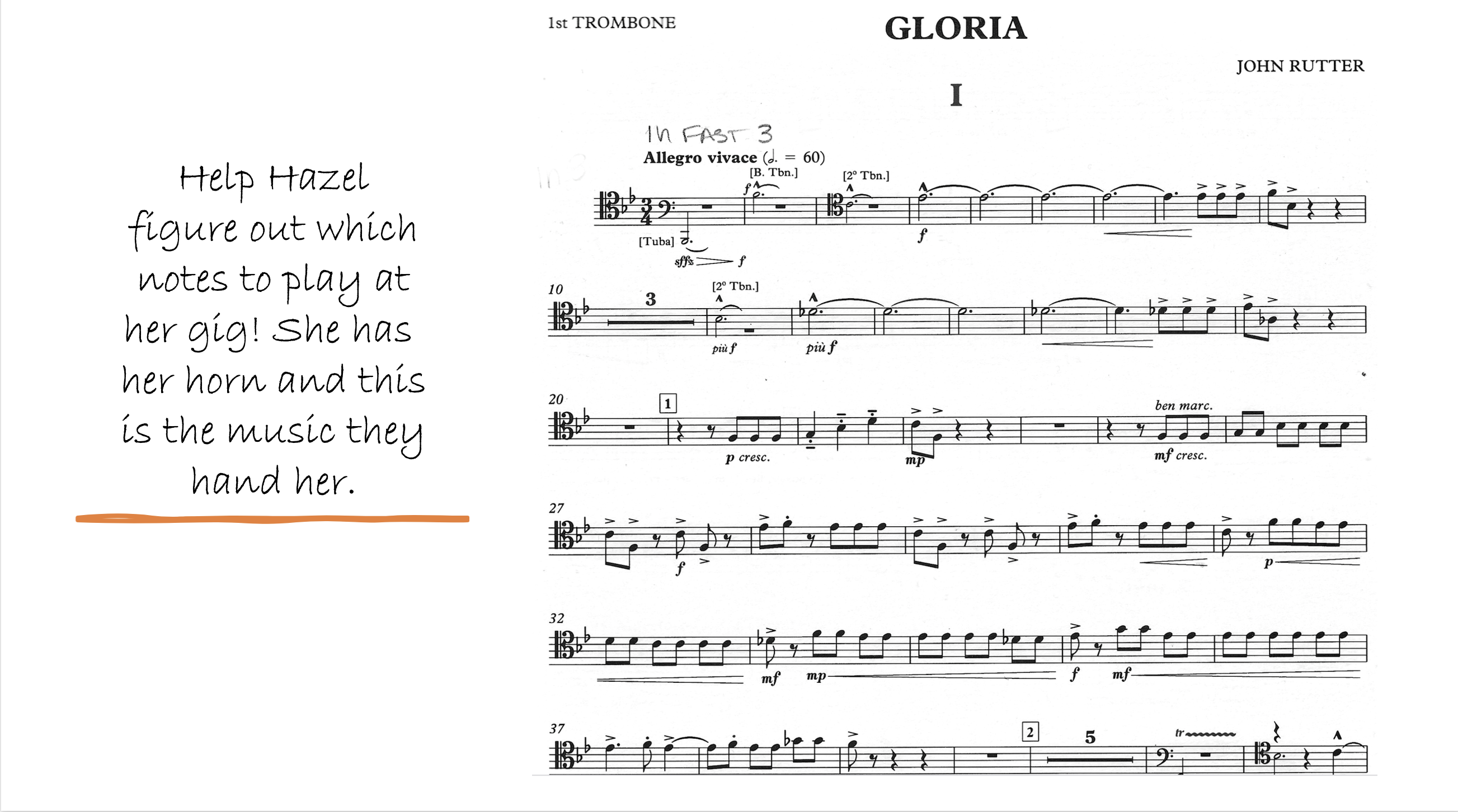
Toolbox Assignment: Help Hazel figure out what notes to play at her gig
Hazel shows up to a morning church gig with her horn and is handed the first trombone part below. Write the note names Hazel should play on her horn from rehearsal 1 to rehearsal 2.
Note: Anything typed here will not be saved. Copy and paste your answers into your toolbox.
More Resources
Notation and Transpositions
- TED-Ed: How to Read Music, presented by Tim Hansen
- Brad Harrison’s 7-Minute Tutorial on Transpositions (YouTube)
- Music Theory Practice: Quiz Yourself on Transposing Instruments