6.4 Practice Fast Passages
Essential Question: What strategies can help you learn fast passages accurately and efficiently?
Learning Fast Passages
Fast passages require careful, strategic practice to build both accuracy and speed. Rather than simply playing a passage over and over at full tempo, effective practice breaks the work into manageable steps and uses varied approaches to strengthen learning.
- Chunk it! Break the passage into small sections and master each one before combining them.
- Work from the back in small bits, perfecting each bit before adding to it.
- Change the rhythm and articulations of the pattern. Learn it with multiple different rhythms and articulations.
- Huff-slur particularly bumpy areas.
- Try an interleaved clicking-up pattern (see below).
Interleaved Clicking-Up
The interleaved clicking-up method is a structured way to build tempo gradually while reinforcing previously learned sections. Here is an example using the Brahms Academic Festival Overture.
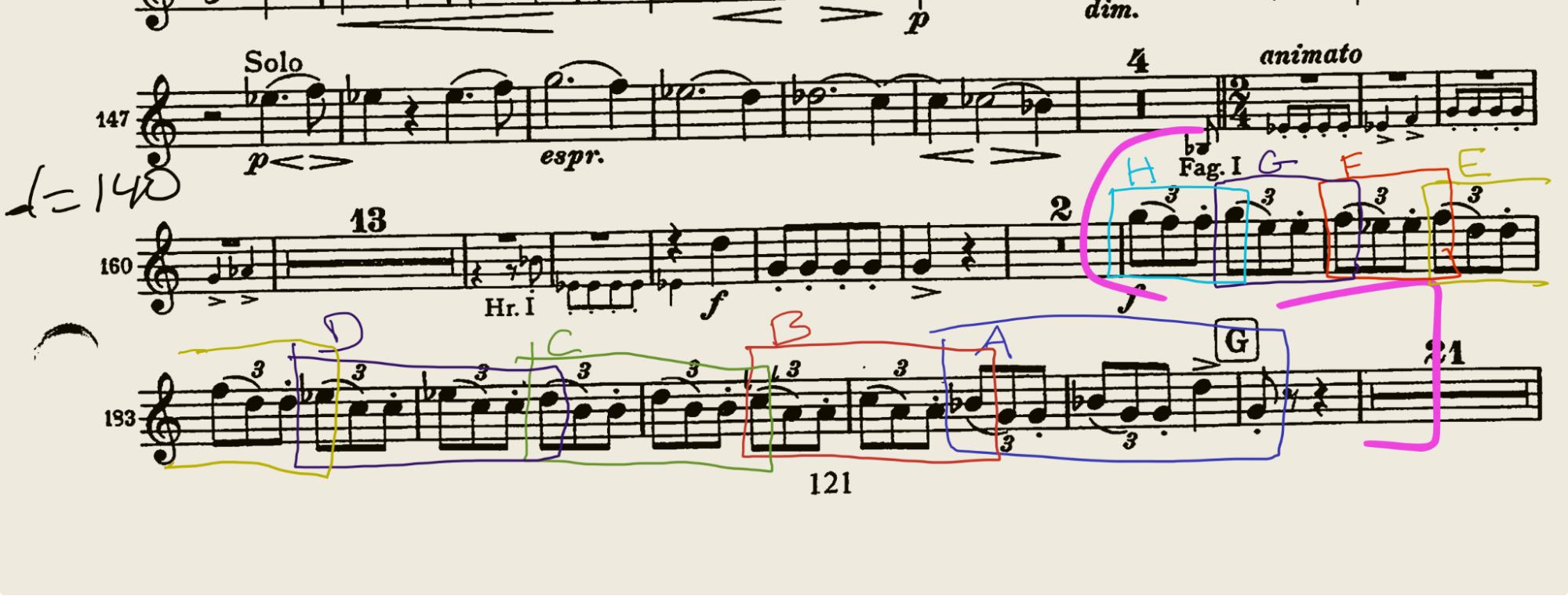
- Play section A at 60 bpm, then at 65 bpm, then 70 bpm, and so on until you reach your goal tempo.
- Play section B and A at 60 bpm, then just section B at 65, then both at 70, and so on until you reach the goal tempo.
- Play section C, B, and A at 60 bpm, then just C at 65, then C and B at 70, then just C at 75, then C, B, and A at 80, then just C, and so on until the goal tempo.
- Continue adding sections until the entire excerpt has been added.
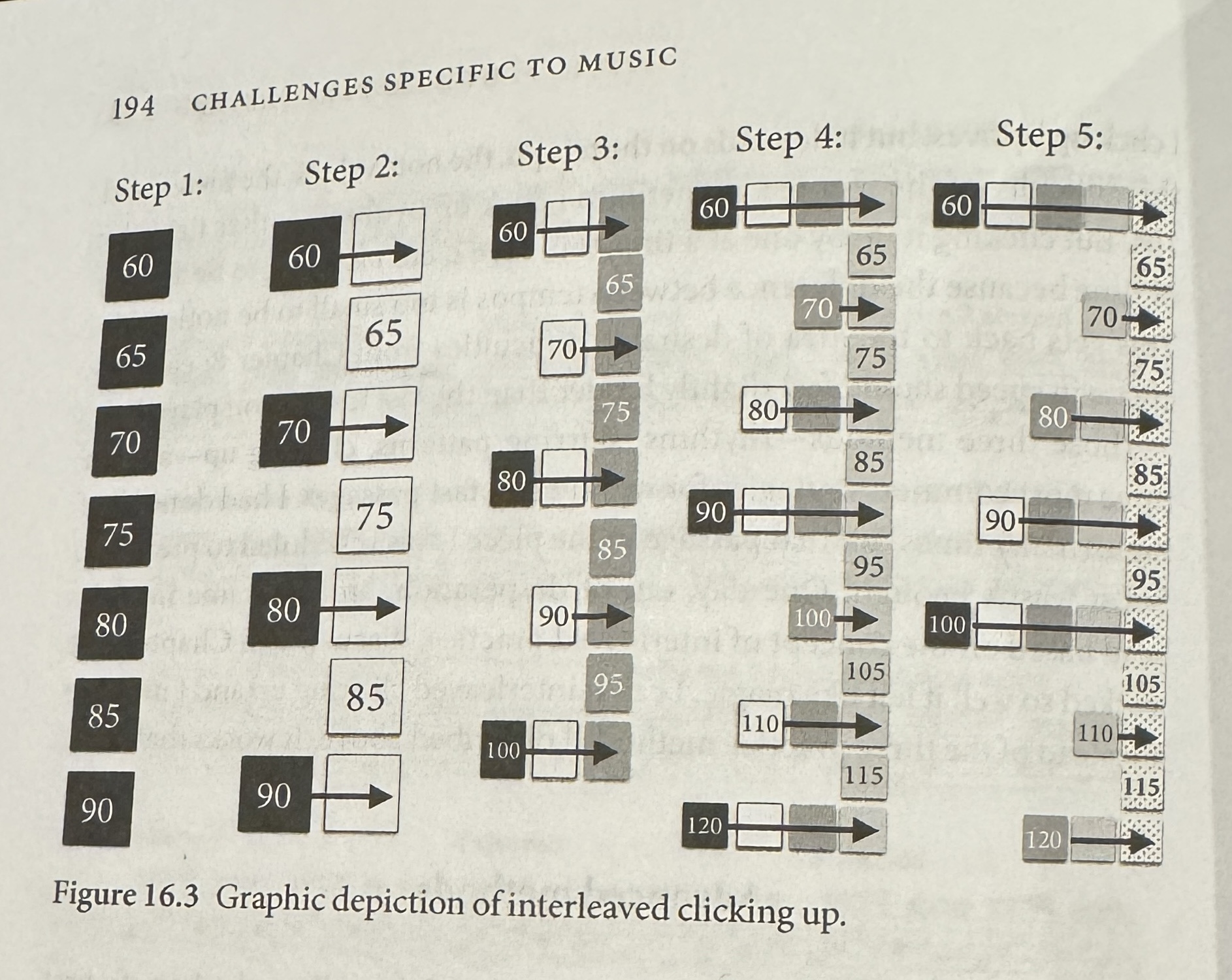
Diagram and method from Molly Gebrian.
Reading: The Myth of Massed Practice
Read this excerpt from the book Make It Stick about why massed practice (repeating the same thing over and over) is less effective than interleaved and spaced practice for long-term retention.