6.5 Learn New Music and Practice Performing
Essential Question: How can you structure your practice to deeply learn new music and reliably perform it under pressure?
The Big Picture: Learning New Music
Think recital or audition preparation! At this stage, the goal shifts from isolated technique work to mastering complete musical passages and performing them with confidence. The strategies in this lesson draw on the principles of spaced practice and self-evaluation to help you move from "learning" a piece to truly "owning" it.
Spaced Practice for Audition Preparation
One way to do spaced practicing for an audition is to randomly divide your excerpt list into groups of approximately 5–7 excerpts. Each day you will take one set (so 5–7 excerpts) and work only on those. Go deep, work hard, be picky. You won’t see these again for many days until you’ve cycled through all your other groups of excerpts.
This method is great for spacing out your practice. By the time the same excerpt comes around again, it will have been just long enough for your muscle memory to start forgetting. As your brain has to recall what you learned days ago and then re-ingrain it, the learning will be deeper and more lasting.
A Spaced Practice Calendar
Here is a more detailed calendar that takes into account that the better you know the music, the longer the break between practice sessions should be. Below is an example practice calendar for solidifying the opening two lines of Mozart Horn Concerto No. 2 in five weeks. That is just a small passage, but you can create overlapping calendars with a bunch of challenging musical selections. Once you have learned these passages, it is time to move on to your "practice performing" techniques (including playing mock auditions for others).
Week 1
- Monday: Practice the opening two lines of Mozart 2 using your favorite techniques. Spend 15 minutes on it 2–3 times during the day. You can practice other stuff in between.
- Tuesday: Same as Monday.
- Wednesday: Same as Monday.
Thursday: Do not practice Mozart 2 opening, but you can practice other stuff.
- Friday: Practice the Mozart passage (along with other stuff).
Saturday: Do not practice Mozart 2 opening, but you can practice other stuff.
- Sunday: Practice the Mozart passage (along with other stuff).
Week 2
Monday: Do not practice Mozart 2 opening, but you can practice other stuff.
- Tuesday: Practice the Mozart passage (along with other stuff).
Wednesday–Sunday: Do not practice Mozart 2 opening, but you can practice other stuff.
Week 3
Monday: Do not practice Mozart 2 opening, but you can practice other stuff.
- Tuesday: Practice the Mozart passage (along with other stuff).
- Wednesday: Practice the Mozart passage (along with other stuff).
- Thursday: Practice the Mozart passage (along with other stuff).
Friday–Sunday: Do not practice Mozart 2 opening, but you can practice other stuff.
Week 4
Monday–Sunday: Do not practice Mozart 2 opening, but you can practice other stuff.
Week 5
Monday–Wednesday: Do not practice Mozart 2 opening, but you can practice other stuff.
- Thursday: Practice the Mozart passage (along with other stuff).
- Friday: Practice the Mozart passage (along with other stuff).
- Saturday: Practice the Mozart passage (along with other stuff).
Check out this video where Molly Gebrian explains how she uses google calendar to keep track of spaced practicing for the most effective learning cadence.
Record and Play Back 3 Times
Method by Sharon Sparrow
Think you have mostly got that passage worked out? Let’s see. Play it through as if you were performing it. Record it!
Now listen back three times, each time listening intently for a specific variable:
- Pulse: Line up a metronome with your first few beats. Then play the metronome while listening to your recording. Did you stay steady? If lining up the metronome is not working, tap along on your metronome app. Aim for perfect time.
- Intonation: Listen back while looking at a tuner or overlaying a drone. Circle anything not in tune and note what is wrong.
- Musical details: Are you playing every articulation, dynamic, musical phrase, etc. exactly as you intended and as the composer asked?
Do not immediately go back and try to fix these things. Just make notes and plan your next practice session to address these issues.
You can record a set of excerpts (say 3–5) and then listen back through each excerpt separately, making sure to do all three listens of one excerpt before moving on to the next one in your recorded mock.
Why Recording and Self-Evaluation Matter
Recording yourself is one of the most powerful and underused tools in a musician’s practice toolkit. When you are in the act of playing, your attention is divided among countless tasks: reading notes, managing breath, shaping phrases, monitoring intonation, and more. It is nearly impossible to objectively hear what you actually sound like while simultaneously producing the sound.
A recording strips away that divided attention and lets you listen as an audience member would. Details that slip past in real time—a slightly rushed transition, a pitch that sags, a dynamic that never quite materializes—become immediately obvious on playback. This is why the three-listen method described above is so effective: each pass focuses your ear on a single dimension, preventing you from being overwhelmed by everything at once.
Self-evaluation through recording also builds critical listening skills that transfer directly to ensemble playing, sight-reading, and live performance. Musicians who regularly record and review their practice develop a more accurate internal sense of how they sound, closing the gap between intention and reality. Over time, this habit trains your ear to catch problems in real time, making you a more self-correcting player even when the recorder is off.
Perhaps most importantly, recording provides an objective record of progress. On days when practice feels frustrating, comparing a current recording to one from weeks earlier can reveal dramatic improvement that was invisible in the moment. This evidence of growth fuels motivation and reinforces the value of disciplined, strategic practice.
Practice Performing
Write out 5–15 passages or excerpts you feel you have learned. It is time to make sure you can perform them, not just "play" them. Shuffle them into a random order.
Perform the first one. One shot, no stopping. Did you nail it? If you miss it, just mentally note what you missed (or pencil in a helpful marking). If you nailed it, put a check mark next to it on the list.
Now perform the next excerpt. One shot, no stopping. Did you nail it? If you miss it, just mentally note what you missed (or pencil in a helpful marking). If you nailed it, put a check mark next to it on the list.
Continue through the list in this manner and then cycle through again. Each subsequent time, either add another check mark if you nail it, or erase ALL the previous check marks if you miss something. Be picky—only put a check mark if you would be happy with that as your final product.
Once an excerpt has 5 check marks, take it off the list. You have learned it. If you get below 5 excerpts on your list, add more. It stops being effective if you cycle back too quickly.
Reading: Practicing Deeply
Read this chapter from Gerald Klickstein’s book The Musician’s Way: A Guide to Practice, Performance, and Wellness (Oxford University Press, 2009). Klickstein describes the foundations of deep practice—mastery, integration, and transcendence—and outlines seven habits of excellence and seven essentials of artistic interpretation that apply whenever you practice or perform.
Toolbox Assignment
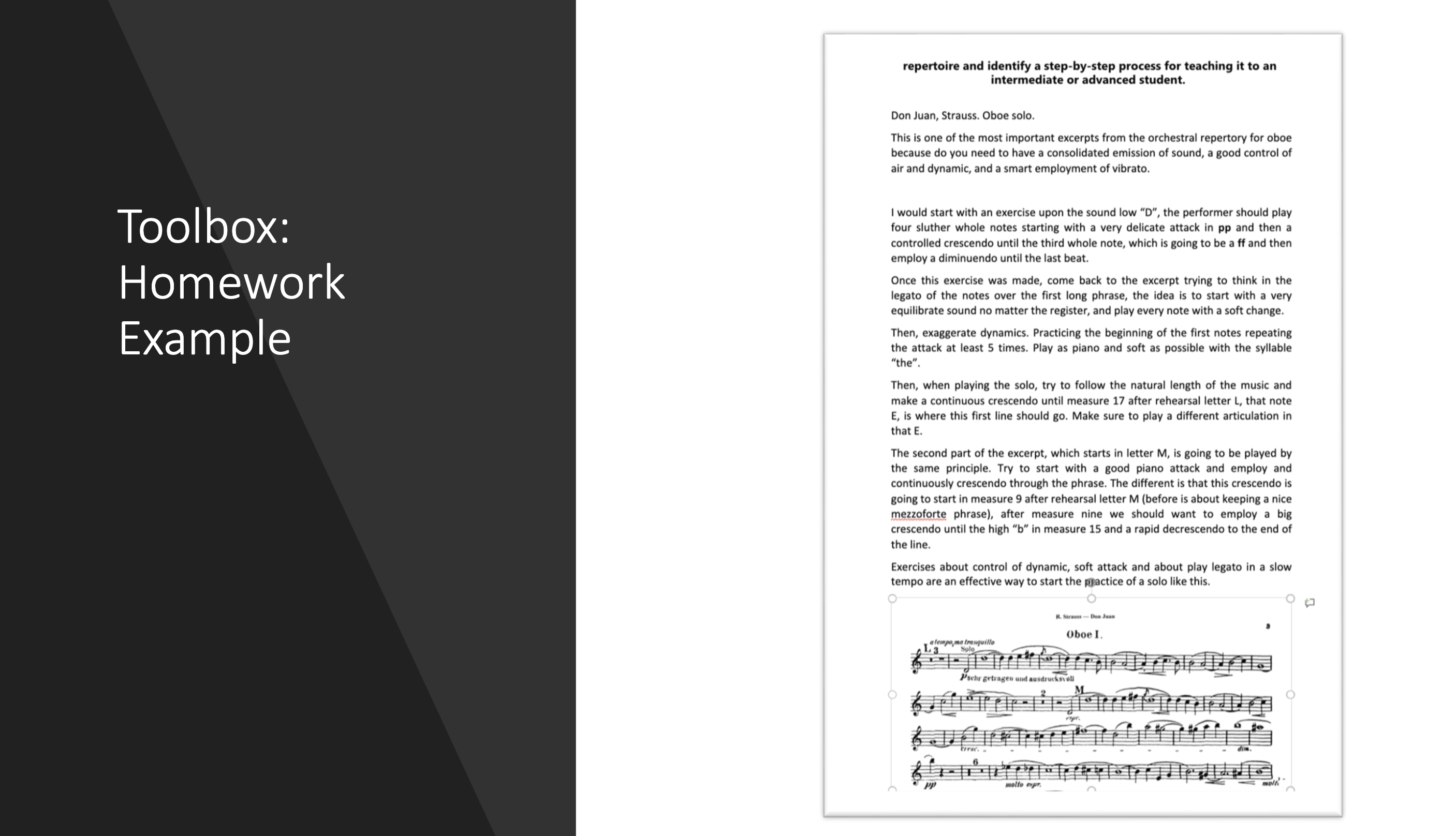
Choose an excerpt and, using what you have learned about the art and science of practicing, identify a step-by-step process for helping a student learn and practice that excerpt.