6.3 Using Solfege, Audiation, and the Kodály Method
Essential Question: How can solfege, audiation, and the Kodály method strengthen musical understanding and internal hearing?
Movable-Do Solfege
Solfege is a system for singing pitches using syllable names: do, re, mi, fa, sol, la, ti. In movable-do solfege, “do” is always the tonic of whatever key you are in, rather than being fixed to a single pitch. This means that the syllables represent scale degrees and intervals rather than absolute pitches.
Because the syllables map to tonal function, movable-do solfege helps students internalize how notes relate to each other within a key. A student who can sing “do–mi–sol” in any key understands the sound of a major triad, not just a set of fingerings. This makes transposition, sight-reading, and ear training far more intuitive.
What Is Audiation?
Audiation is the ability to hear and comprehend music in your mind without any sound being physically present. It goes beyond simple memorization—it is the process of thinking in music, much the way fluent readers process language silently. A musician with strong audiation skills can look at a score and hear it internally, anticipate what comes next in a phrase, and self-correct in real time.
Zoltán Kodály and the Kodály Method
Zoltán Kodály (1882–1967) was a Hungarian composer, ethnomusicologist, and educator who believed that music literacy should be as universal as language literacy. He spent decades collecting Hungarian folk songs and integrating them into a progressive, voice-centered approach to music education. His philosophy placed singing at the foundation of all musical learning, arguing that the voice is the most natural and accessible instrument.
The Kodály method uses movable-do solfege, hand signs, and rhythm syllables to develop inner hearing, reading skills, and musical independence from an early age. His ideas have influenced music education worldwide and remain deeply relevant for instrumental teachers today.
“We should read music in the same way that an educated adult will read a book: in silence, but imaging the sound.”
Incorporating Solfege, Singing, and Audiation into Lessons
Solfege and Sight Singing
Singing is one of the most direct ways to build pitch awareness, musical understanding, and internal hearing. Even very simple exercises can have a big impact.
Start by giving the student a reference pitch. Then ask them to sing a simple melody that you provide, or even a short excerpt from their current repertoire. Begin with neutral syllables such as “lu” to keep the focus on pitch and flow. Once they are comfortable, add solfege syllables.
Using movable do can help students understand relationships between notes within a key rather than relying on absolute pitch. This reinforces tonal function and makes transposition much more intuitive.
Stick notation is a helpful tool for teaching these relationships. In stick notation, rhythms are written using standard note values, but the notes are not placed on a traditional staff. Instead, they are shown as “sticks” or note stems without fixed pitch placement. The solfege syllables are written below each note to indicate pitch relationships within the key.
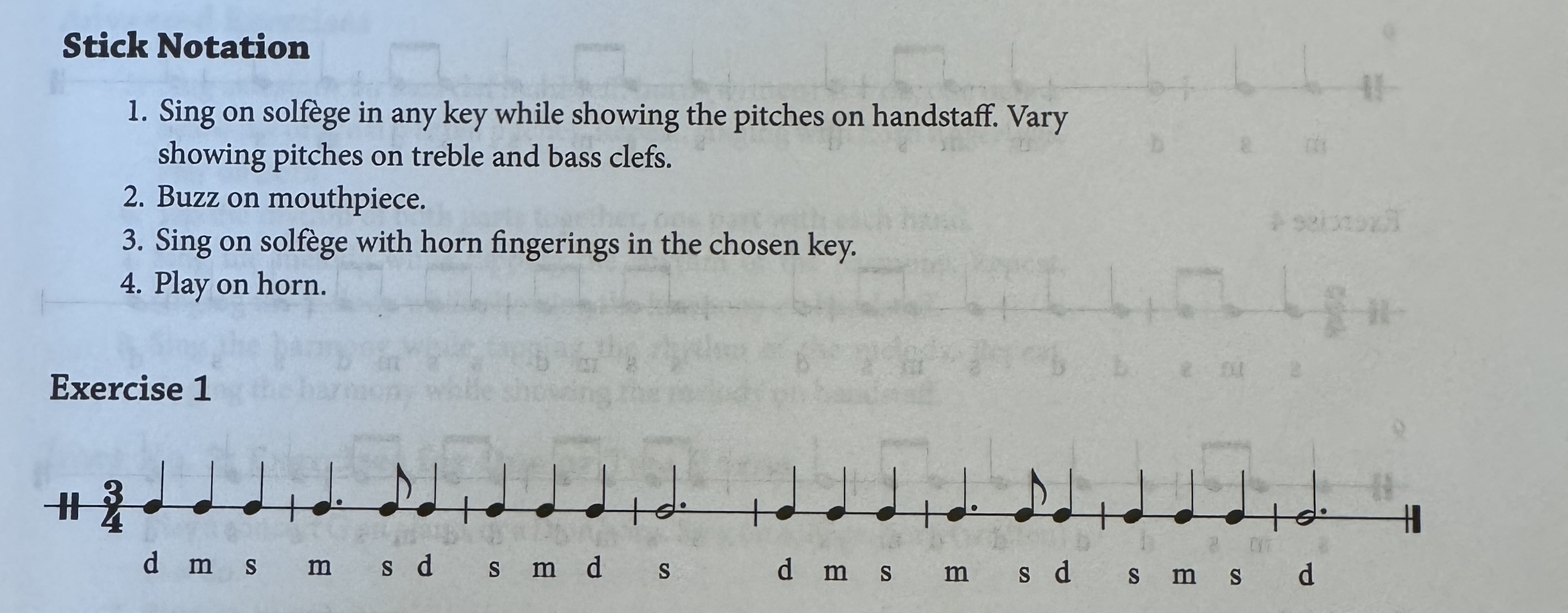
Because the notation does not lock the notes into a specific staff position, the same pattern can easily be sung in any key by choosing a new starting pitch and maintaining the solfege relationships.
Brass players can extend this work by buzzing simple melodies on the mouthpiece. This reinforces pitch accuracy and strengthens the connection between hearing and playing. It is helpful to check pitch regularly so students learn to adjust and stay centered within the key.
Audiation
Audiation is the ability to hear music in your mind without producing sound. Developing this skill strengthens accuracy, confidence, and musical independence.
A simple way to introduce audiation is with a familiar tune such as “Mary Had a Little Lamb.” Have the student sing the melody using either solfege or the original words. Then repeat the melody while the student watches your hand.
When your palm is facing up, the student sings out loud. When your palm is facing down, they continue singing, but only in their head. Alternate between out-loud singing and silent audiation, and then check whether the student has stayed on pitch when they come back in.
For brass students, this same exercise can be adapted by using mouthpiece buzzing for the out-loud portions. This helps connect internal hearing directly to sound production.
Practice the exercises below. While the exercise was designed for horn players, you can use it with any instrument.
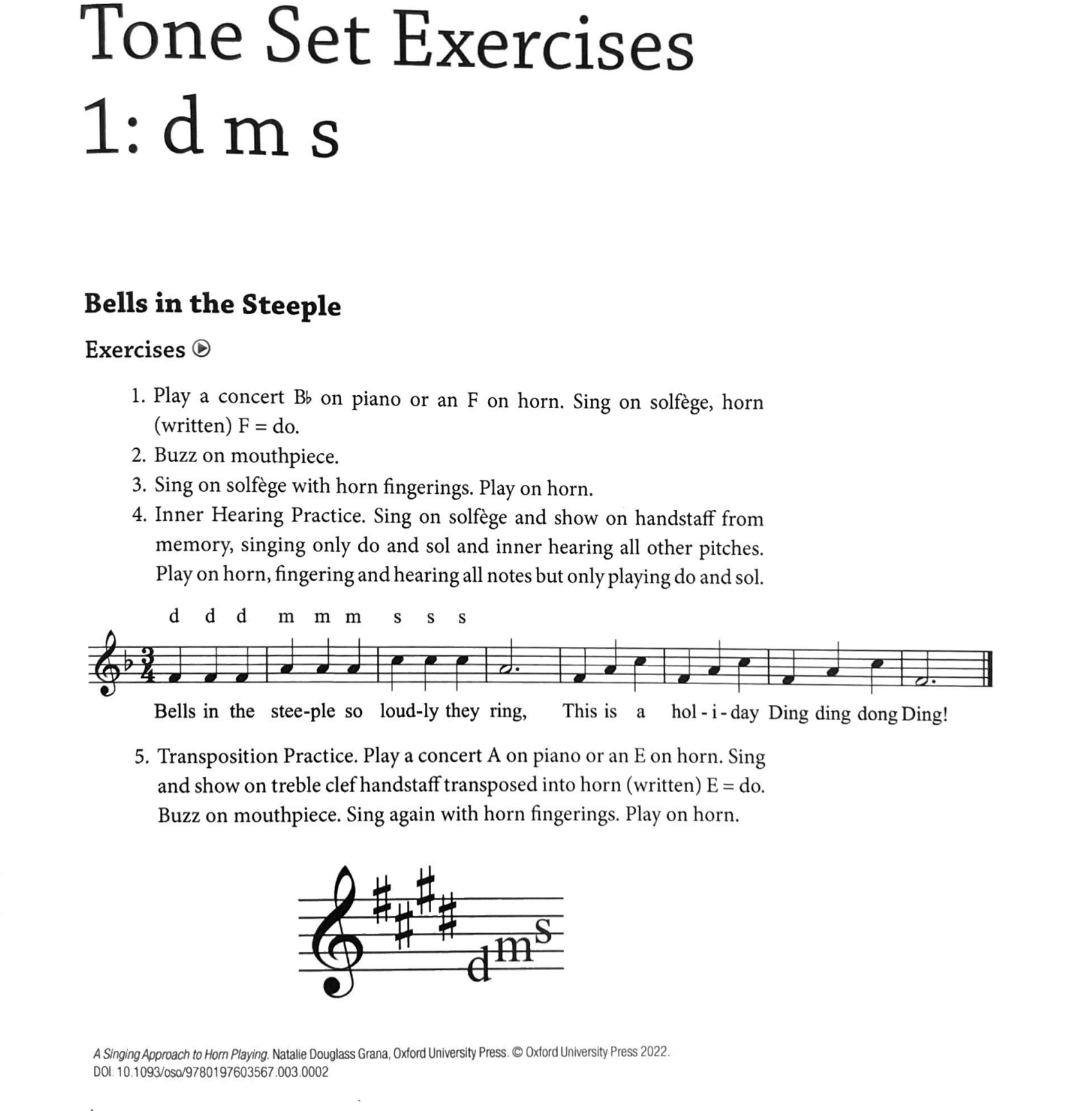
For more exercises and videos to sing along to, check out this site put together by Kodály expert and horn player, Natalie Grana, and Oxford Press.
Reading: Kodály Strategies for Instrumental Teachers
Read this article about other ways of incorporating Kodály strategies into instrumental teaching.