5.3 Brass Sound Production
Essential Question: How is sound created and sustained on a brass instrument, and how is it similar to—and different from—woodwind instruments?
“In brass playing, the instrument doesn’t just respond to the player — the player and instrument form a coupled system.”
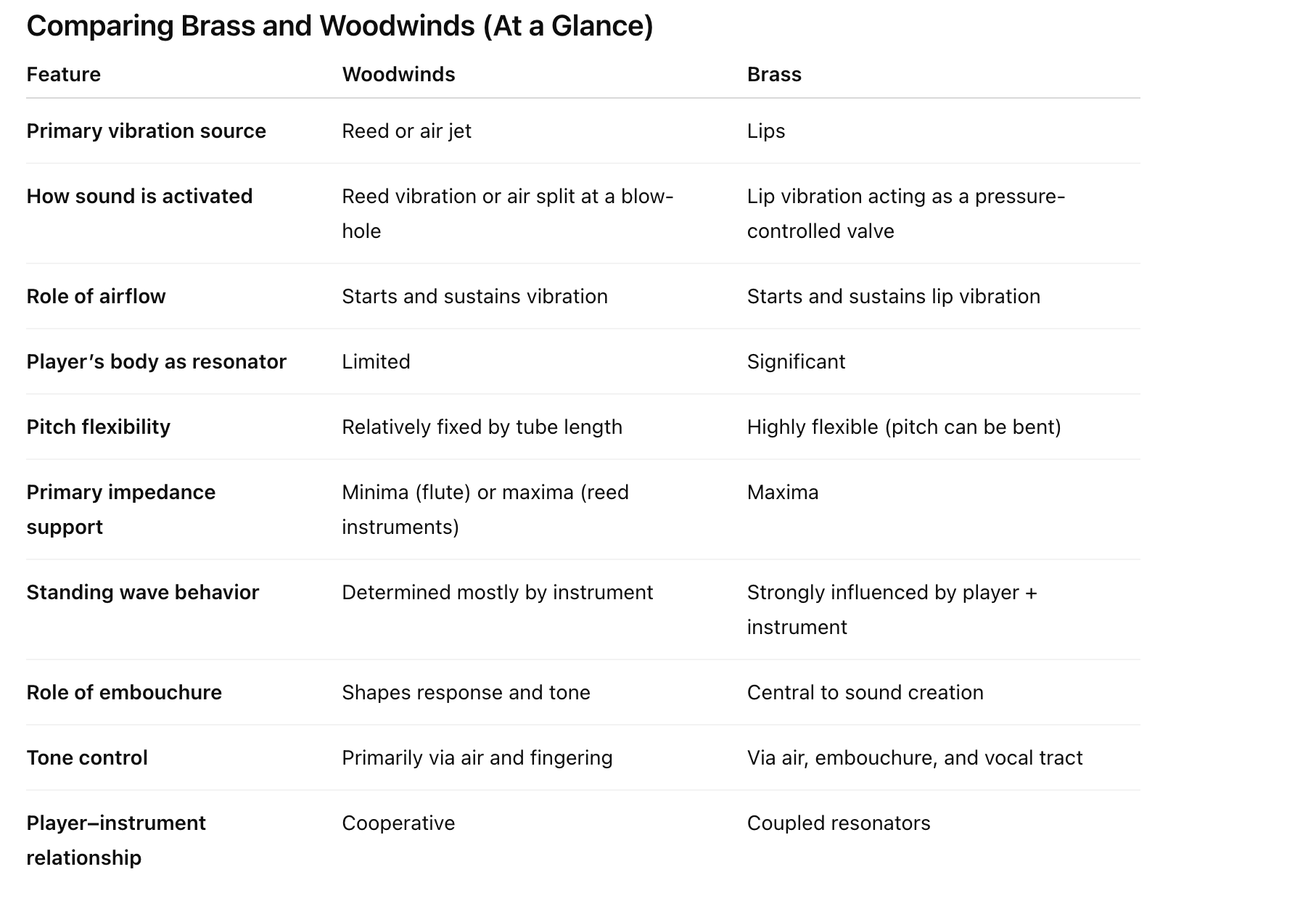
Brass instruments produce sound through vibrating lips interacting with pressure waves inside the instrument. Like woodwinds, brass instruments rely on pressure waves traveling, reflecting, and forming standing waves. The key difference is how those waves are activated and how strongly the player’s body participates in the system.
Brass instruments are best understood as coupled resonators:
- the external instrument (the brass instrument itself), and
- the internal instrument (the mouth, pharynx, sinuses, etc)
Sound emerges from the interaction between these two systems coupled at the lips.
Review: What do Brass and Woodwinds Have in Common?
Both brass and woodwind instruments:
- create sound by activating pressure waves, not moving air
- rely on reflections from the bell or open end
- form standing waves that determine pitch
- feel most stable when reflected waves return in phase with the player’s vibration
In both families, tone and pitch stability depend on matching the player’s vibration to the instrument’s resonances.
Key Differences in how the Sound Wave Is Activated
Woodwinds:
- Sound is activated by:
- a vibrating reed, or
- an air jet across a blow-hole (flute)
- The vibration source is largely external to the player’s body
- The instrument strongly determines which frequencies are favored
Brass:
- Sound is activated by vibrating lips acting as a pressure-controlled valve
- The lips are part of the player’s body
- This makes the player a much more active part of the resonating system
- In brass playing, the vibration source and the resonator are tightly linked.
The Lips as a Pressure-Controlled Valve
In brass instruments:
- Air pressure behind the lips forces them open
- As air flows, pressure drops and the lips close
- This open–close cycle repeats rapidly
Pressure waves reflecting back from the bell:
- do not force the lips open
- instead, modify the pressure at the mouthpiece
- helping coordinate when the lips open and close
Stable sound occurs when lip vibration and reflected pressure waves reinforce each other.
Coupled Resonators: The Instrument and the Body
A resonator is any system that naturally vibrates at certain frequencies.
In brass playing, two resonators are coupled at the lips:
1. The Instrument
- Long metal tube with a specific length and shape
- Supports certain frequencies more strongly than others
- Creates peaks in input impedance that stabilize pitch
2. The Player’s Body
- Oral cavity
- Pharynx and vocal tract
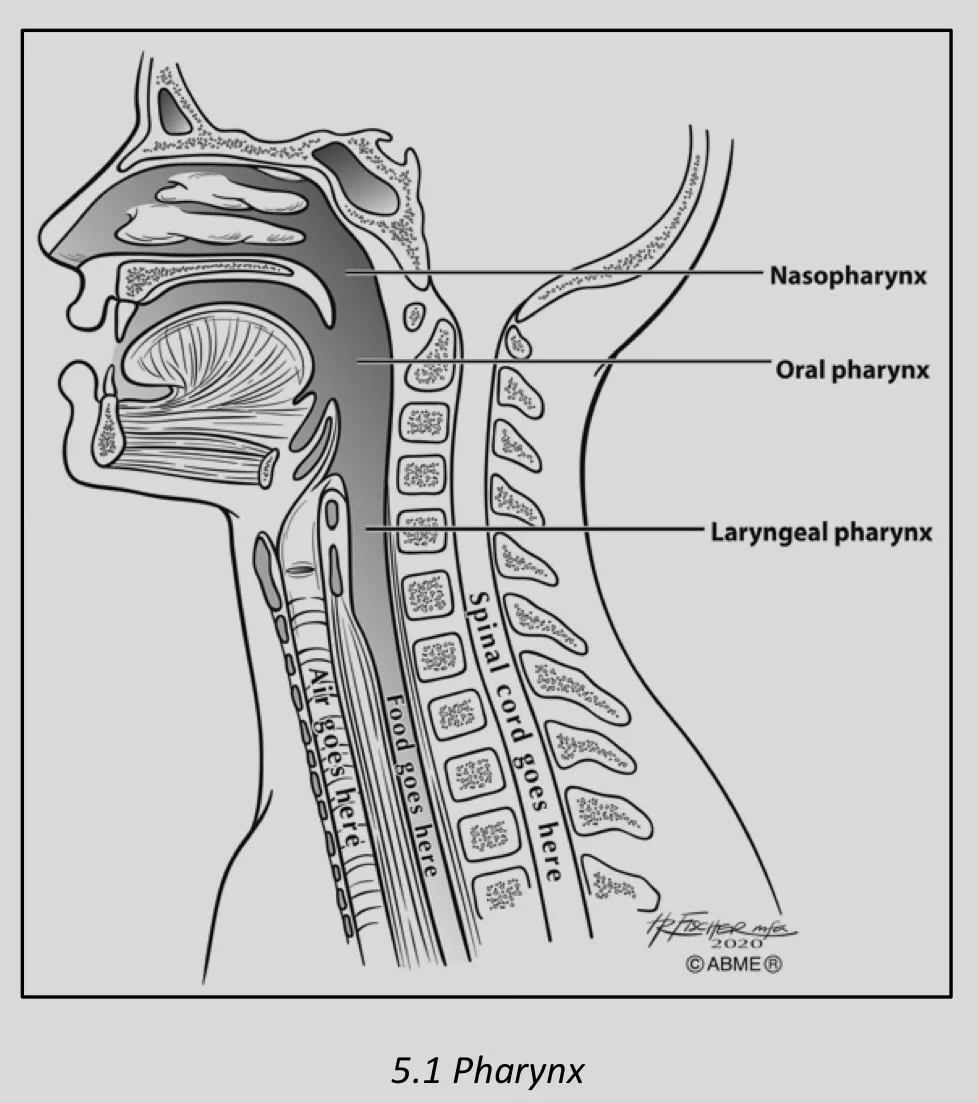
Note: if you look at the pharynx image, you’ll notice that the long laryngeal pharynx that splits into the nasopharynx (which remains open at the nose) and the oral pharynx (which can close at the lips) creates an internal instrument shaped like a bassoon!
These body resonators:
- have their own natural frequencies
- can be adjusted consciously and unconsciously
Sound is most efficient when the player’s resonances align with the instrument’s resonances.
Input Impedance in Brass Instruments
Like woodwinds, brass instruments have an input impedance curve.
For brass:
- playable notes occur at impedance maxima
- these peaks provide resistance that helps sustain lip vibration
The height and narrowness of these peaks influence:
- slotting
- stability
- ease of response
Standing Waves in Brass
When the pressure wave moving inside a brass instrument hits the sudden flaring end (the bell) of the instrument, it causes much of the energy in the pressure wave to bounce back the other way. When this happens, there’s a pressure wave moving forward and another pressure wave moving backward. At certain frequencies, the two moving pressure waves add and cancel together in way that causes the high pressure and low pressure spots to become stationary. This is called a standing wave.
The high pressure locations are the nodes. The harmonic series is the set of frequencies that result in a standing wave for a given length of pipe. Without a standing wave, the energy reflected back towards the mouthpiece will disrupt the vibrating lips, and that’s why it is very difficult to get the lips to vibrate continuously at frequencies other than the harmonic series.
Sometimes a brass player will manipulate their facial muscles to allow the lips to vibrate at a frequency away from the harmonic series—for example, when they do pitch bends. At low frequencies, we can force our lips to vibrate quite far from the harmonic series frequencies. At high frequencies, we can do it just a little bit or barely at all.
Why practice long tones?
In very general terms (with apologies to the physicists out there),
- High notes require less air but faster, more pressurized air.
- Lower notes require more air, but at a lower pressure (slower speed).
- As dynamics go up, both the air pressure and air quantity increase.
The brass player must continuously adjust the balance between pressurized air, lip-tension, and air quantity to produce sounds across the range and at all dynamic levels. For example:
- If a brass player is holding a given pitch and increases the air speed while maintaining a constant lip tension and mouth shape, the pitch will jump to the next highest partial in the harmonic series. Likewise,
- if a brass player increases the lip tension or narrows the mouth shape while maintaining constant air speed, the pitch will also jump to the next highest partial.
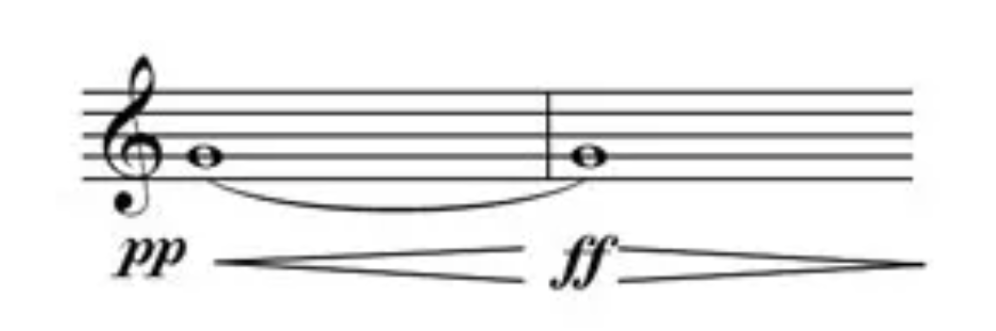
Meanwhile, crescendoing on a note requires increasing the air speed. Therefore, in order to crescendo on a given note while maintaining pitch, the player must subtly decrease the lip tension as they increase the air speed. Likewise, to diminuendo on a note while maintaining a steady pitch, the player must subtly increase the lip tension as the air speed slows. This delicate balance is why long tones are such an essential part of a brass player’s daily practice.
Why practice “the path”?
To review, the harmonic series (sometimes nicknamed “the path”) is the predictable pattern of pitches that can be produced on a brass instrument without changing the tube length. The music staff shows the natural harmonic series starting on the fundamental C. This is the series for an F horn.

Brass players often practice the harmonic series as part of their warm-up because it directly trains the muscle memory to balance the lips, air, and instrument to work together to produce a resonant sound.
For any given tube length:
- The fundamental (lowest possible pitch) is produced by the longest standing wave.
- Higher notes in the harmonic series are produced by shorter standing wave patterns that still fit inside the same tube.
- As the player goes higher in the series, the notes get closer together.
The instrument strongly supports these pitches because they align with impedance peaks — places where the pressure waves reflect back in phase with the vibrating lips.
Practicing the harmonic series helps players:
- align lip vibration with the instrument’s resonances
- improve flexibility and efficiency
- develop accurate pitch placement
- feel impedance support instead of fighting it
In other words, harmonic practice teaches players how to cooperate with the physics of the instrument.
The Natural Horn
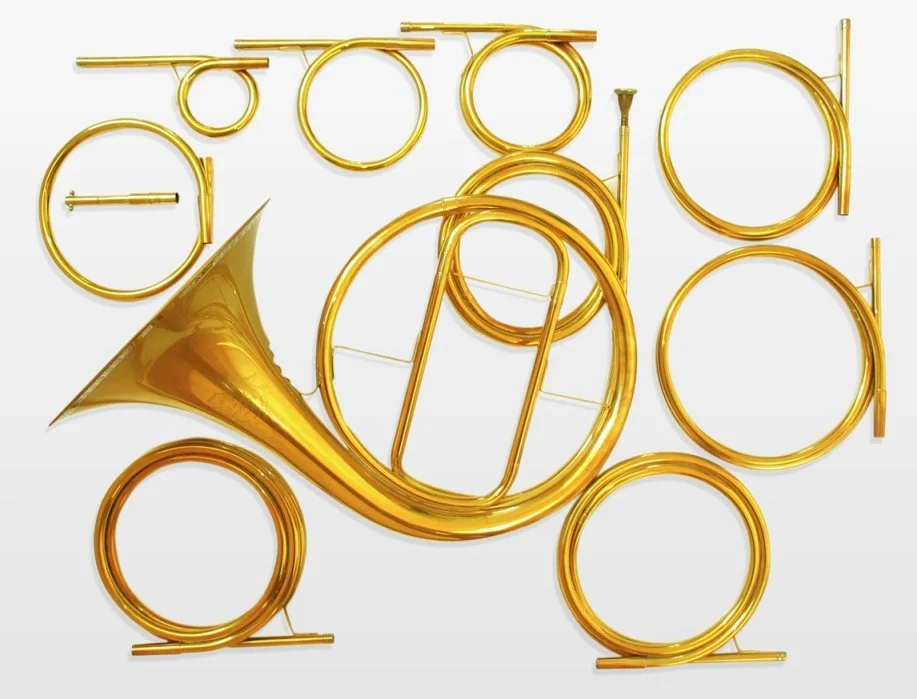
Before valves were invented, horn players used the natural horn, which had no valves and no keys. Pitch changes were achieved by physically changing the length of the tubing. A natural horn pitched in F is approximately 12 feet long. That length determines the fundamental pitch (F) and the entire harmonic series above it. The player can produce only the notes in the F harmonic series. The player selects which notes by adjusting the oral cavity, embouchure shape, and air speed.
If a natural horn player wants to play in a different key they would physically remove the F crook (a section of tubing), and replace it with a shorter or longer crook. Each crook creates a new tube length, which produces a new fundamental pitch and harmonic series. Horn players used to have to carry a whole suitcase of different crooks. This also explains why natural horn parts only contain the notes within the natural harmonic series and rests are required to allow the horn player to switch crooks. By the classical period, horn players learned to use their right hand to change the tube length, allowing for more frequencies to be played without changing crooks. But using the hand also changed the sound, so it wasn’t until the invention of the valved horns in the 1850s that horn players could play chromatic passages with an even tone color.
Valves: The Modern Solution
Modern brass instruments use valves to change tube length instantly. Each valve adds a specific length of tubing. Opening and closing valves changes the effective tube length. Each new tube length produces a new harmonic series. Rather than swapping crooks, modern horn players choose a valve combination, then select the desired note from that harmonic series using their lips and air.
This is why every brass note is really a two-part choice:
- Tube length (set by valves or slide)
- Harmonic (chosen by the player)
Learning Check
3 points possible (ungraded)
1. What does it mean that brass instruments involve coupled resonators?
2. Why can brass players bend pitch more easily than woodwind players?
3. What role do reflected pressure waves play in brass playing?