5.4 Laminar vs Turbulent Flow
Essential Question: How do laminar and turbulent airflow affect tone production in wind instruments?
Laminar Flow vs Turbulent Flow
Continuing with our physics generalizations and hand waving, let’s take a look at laminar and turbulent flow.
- Laminar Flow is smooth air
- Turbulent Flow is chaotic air
Poisueille’s Law shows that if you increase the pressure at the input of a tube, the flow rate will increase in proportion. In other words, if you pressurize the air in a tube, the air speed will increase in proportion. Poisueille’s Law only applies to laminar (smooth) flow.
For turbulent (chaotic) flow, this relation does not hold. Increasing the pressure at the tube’s input doesn’t make the flow rate go up proportionately.
As a way to conceptualize the air used in brass playing, let’s say that efficient, well-pressurized air that cooperates with the instrument is laminar flow. The blow is smooth and follows Poisueille’s Law: if the player pressurizes the air, the air will respond by speeding up.
In brass playing, we may experience turbulent flow if the mouth shape and lip tension are not properly aligned for the airflow. Sometimes a brass student will try to crescendo but feel as though they hit a wall. They blow harder and harder, but cannot make the air go through the mouthpiece any faster. It often feels as though the air is rattling around in the mouth, distorting the sound. The sound becomes “bumpy”, much like an airplane flying through turbulence. No amount of blowing will fix the sound. Instead, the player must adjust their aperture or mouth shape or body tension to allow the air to smooth. Only then will the wall disappear and the note crescendo.
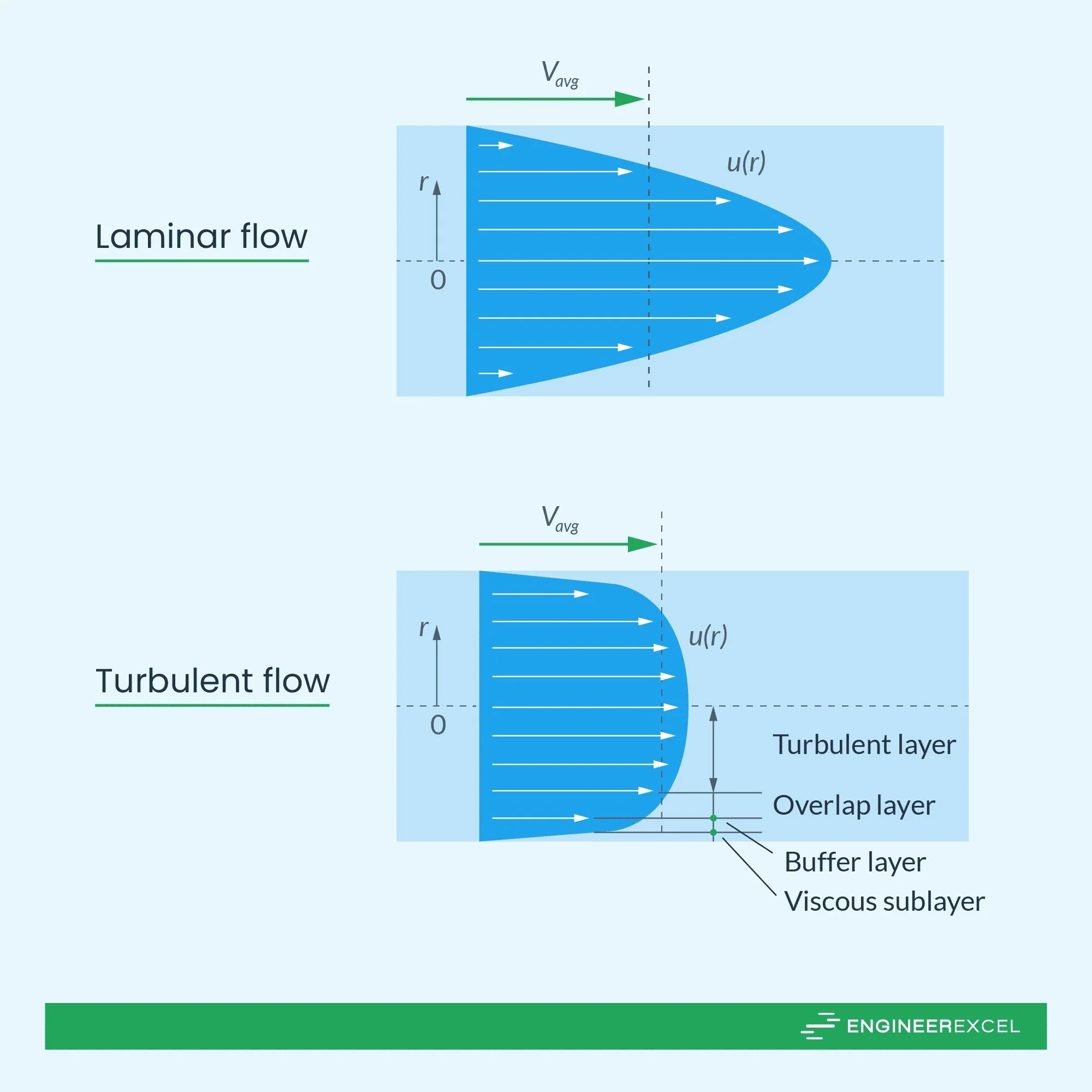
In the diagram below, for laminar flow, the highest velocity air is right in the middle of the flow. This suggests that, with laminar flow, you can “aim” the highest velocity air right at the aperture. In turbulent flow, the highest velocity air is spread across almost the entire tube, which means that one is effectively trying to push a bunch of air against the inside of the almost closed lips, instead of through the aperture. That may be the “wall” feeling described above.
Why some notes feel “locked in”
At resonance peaks:
- The horn strongly reinforces the pitch.
- You feel resistance that’s helpful.
- Slotting feels secure.
- Tone centers easily.
Between resonances:
- Input impedance is lower.
- Less feedback to the lips.
- Notes feel slippery, thin, or unstable.
- This is where players panic and do something unwise with their face.
That “center” we talk about? That’s impedance alignment.
The player side of the equation
Your body also has impedance—your lips, oral cavity, throat, and air column all matter.
Good playing happens when:
- Lips vibrate freely (not clamped)
- Air is moving, not forced
- Throat stays open
- Abdominal muscles are active only to aid the diaphragm back to rest, never locked or bearing down.
- You allow the instrument’s impedance to do its job
If you over-muscle the sound, you override the system instead of partnering with it. That’s how we end up with a lot effort and very little payoff.
Practical teaching takeaways
- Tone work: teaches players to feel impedance matching.
- Slurs and natural harmonic work: trains cooperation for resonance.
- If a note feels bad, ask, Am I fighting the horn, or listening to it
- As Yo-yo Ma says, Draw the sound out of the instrument, don’t force it.