5.2 Woodwind Sound Production
Essential Questions: How does sound creation vary for open and closed pipes?
Resonance and Impedance
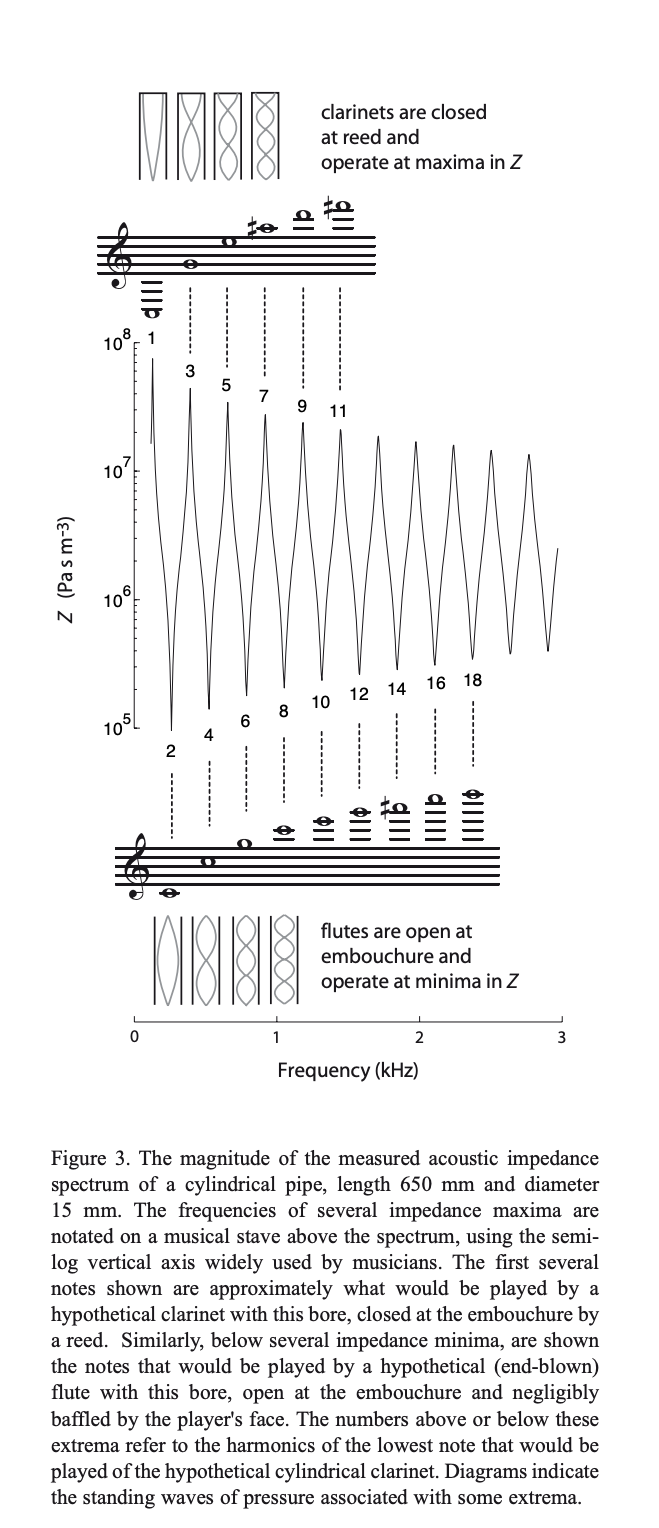
Input Impedance
Input Impedance(Z) describes the way the instrument resists and responds to the vibration triggered by the player. It is determined by taking the Acoustic Pressure (p) and dividing by the Acoustic Volume Flow. (U)
An imput impedance graph shows how strongly the instrument supports different frequencies.
- Strong support = easier, more stable notes
- Weak support = less stable, harder-to-center notes
Pressure and Flow in Pipes
- Acoustic pressure (p): near zero at an open end, near maximum at a closed end
- Acoustic flow (U): near maximum at an open end, near zero at a closed end
Open Pipes vs. Closed Pipes
Open–Open Pipes (Flute)
- Both ends of the tube are open to the atmosphere.
- Pressure variation is near zero at both ends.
- Reflected waves return as low-pressure pulses.
Closed–Open Pipes (Reeds and Brass)
- One end is effectively closed by the player.
- The other end (bell) is open.
- Pressure variation is high at the closed end and low at the open end.
Animations illustrating this difference can be found at https://www.phys.unsw.edu.au/jw/flutes.v.clarinets.html
Woodwinds have a narrow air column.
- With all tone holes closed, the tube is longest → lowest notes
- Opening tone holes shortens the tube → higher notes
- A shorter tube means the pressure wave completes its round trip faster
Flute
- Cylindrical pipe open at both ends
- Sound is activated by a jet of air directed across the blow-hole
- The jet excites the air inside the flute, setting the pressure wave in motion
Because the flute embouchure is open to the atmosphere:
- acoustic pressure variation is very small
- acoustic flow variation can be large
Flute notes occur at minima of input impedance (low pressure, high flow).
- Deeper, narrower minima provide stronger pitch stability
- Resonance also depends on how well the overtones align with impedance minima
The lowest flute note requires one round trip of the sound wave. The flute can play all the harmonics by changing air speed and direction.
Clarinet
- Mostly cylindrical pipe
- Open at the bell, closed at the mouthpiece by the player
- A single wooden reed vibrates against the mouthpiece
How it works:
- Air pressure opens the reed
- Pressure drops → reed closes
- Pressure builds again → reed opens
The reed vibrates in cooperation with the tube's natural frequencies.
Because the reed is sealed in the mouth:
- pressure variation is high
- flow variation is smaller
Clarinet notes occur at maxima of input impedance.
- Taller, narrower peaks provide stronger pitch stability
- Resonance depends on alignment of both the fundamental and overtones
The lowest clarinet note requires two round trips of the sound wave. Because of its closed-end behavior, the clarinet does not play even harmonics.
Higher notes are accessed using the register key, which helps shift to higher resonances.
Saxophones and Double Reeds
These instruments are:
- closed at one end (reed),
- but conical rather than cylindrical.
A conical pipe behaves acoustically like an open pipe:
- the lowest note requires one round trip of the sound wave
- the full harmonic series is available
Saxophone:
- Uses a single reed (similar function to clarinet)
- Conical bore allows access to all harmonics
Oboe and Bassoon:
- Use double reeds (two reeds vibrating against each other)
- The player's air excites and sustains the vibration
- Pitch and stability depend on airflow, embouchure, and impedance matching
Key Takeaway
Woodwind sound is not air rushing through a tube — it is a carefully timed conversation between pressure waves and the player. When the instrument and player cooperate, sound becomes stable, resonant, and expressive.
Learning Check
4 points possible (ungraded)
1. In an open pipe, what happens when a pressure wave reaches the end of the tube?
2. Input impedance describes:
3. Opening tone holes raises pitch because:
4. Which reed instrument behaves acoustically like an open pipe?