5.1 Physics of Sound (Simplified)
Essential Question: How is sound created on a wind instrument?
“You’re not blowing air through the instrument — you’re setting pressure waves in motion inside it.”
Sound on a wind instrument is created when the player activates pressure waves inside a tube of air. These pressure waves travel through the instrument, reflect back, and interact with the player’s embouchure or reed. When this interaction is stable and repeating, we hear a clear pitch.
Air flow is necessary to start and sustain sound, but airflow itself is not the sound. The sound is the motion of pressure waves inside the instrument.
What is a sound wave?
In a wind instrument, sound is a repeating pressure pulse that travels down the air column, reflects back, and sets up a regular vibration we hear as pitch.
The sound waves within the instrument are activated by the player. Air flow through the instrument is not what produces sound, even though we often use that imagery in wind/brass pedagogy. It is the motion of the sound wave within the instrument that creates the sound. The vibration activated by the player creates a pulse of air which compresses the air in front of it, increasing the pressure, this continues down the length of the pipe. It’s a bit like a slinky. In the video below, you can see the wave move even though the physical slinky is staying in place
In a wind instrument, a sound wave is a repeating pressure pulse that:
- travels down the air column,
- reflects back from the end of the instrument,
- and forms a regular vibration we hear as pitch.
When a wind instrument is played, the sound waves within the instrument COLLABORATE with the lips/reed/air to produce a sound. The sound the emerges is due to many factors, including the instrument material, tube length, bell shape, and even the player’s own body.
The sound wave reflects back when it reaches the end of the tube due to the pressure drop that occurs at the open end.
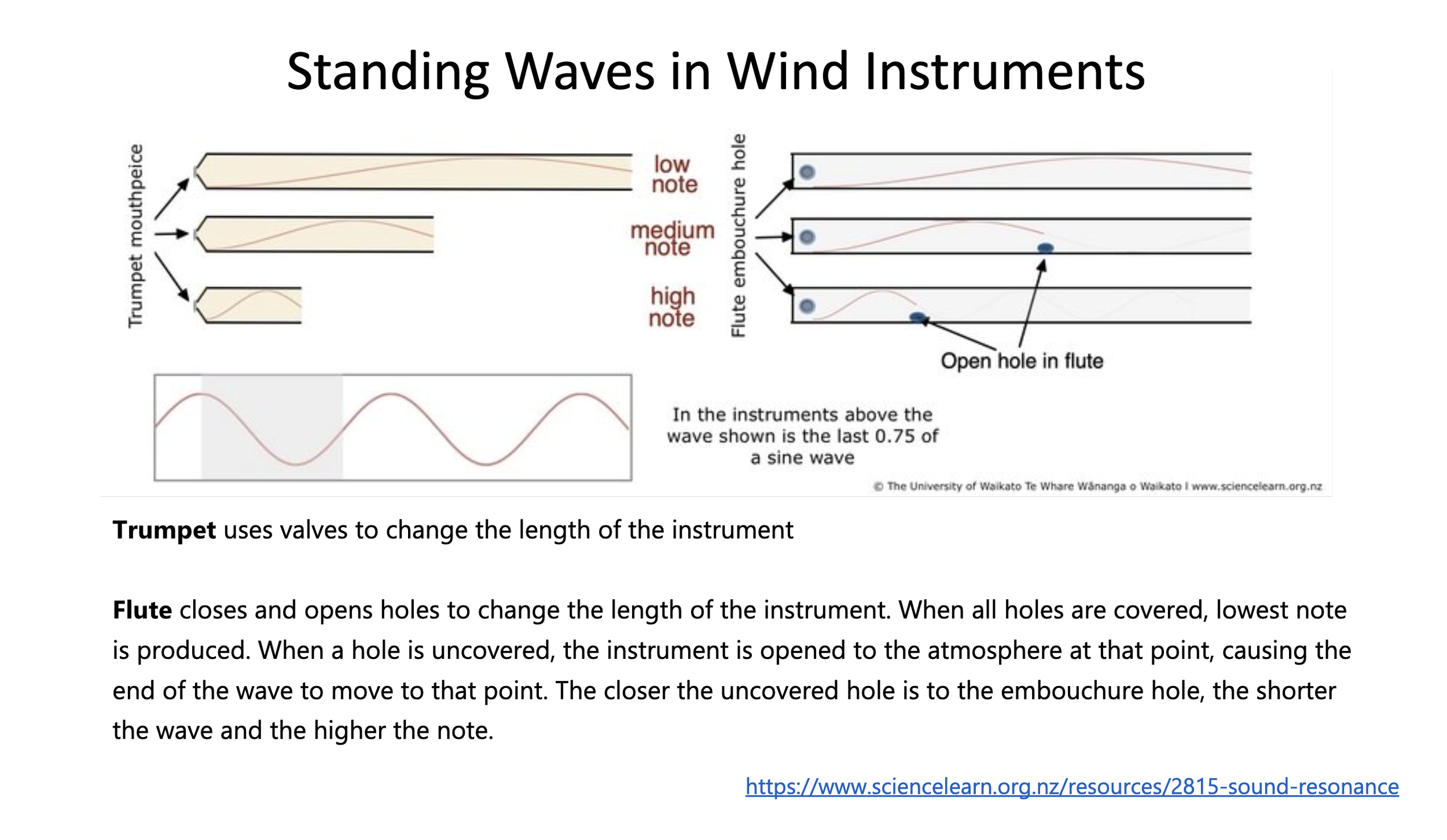
The sound wave traveling back and forth creates a standing wave. For a given length of tubing, the standing wave will include the a pattern of overtones (harmonics). The player can choose which note of those is sounded by adjusting the air flow
A note will sound most resonant and stable if the pressure waves reflecting back from the bell is in phase with the driving pressure at the lips/reed/hole.
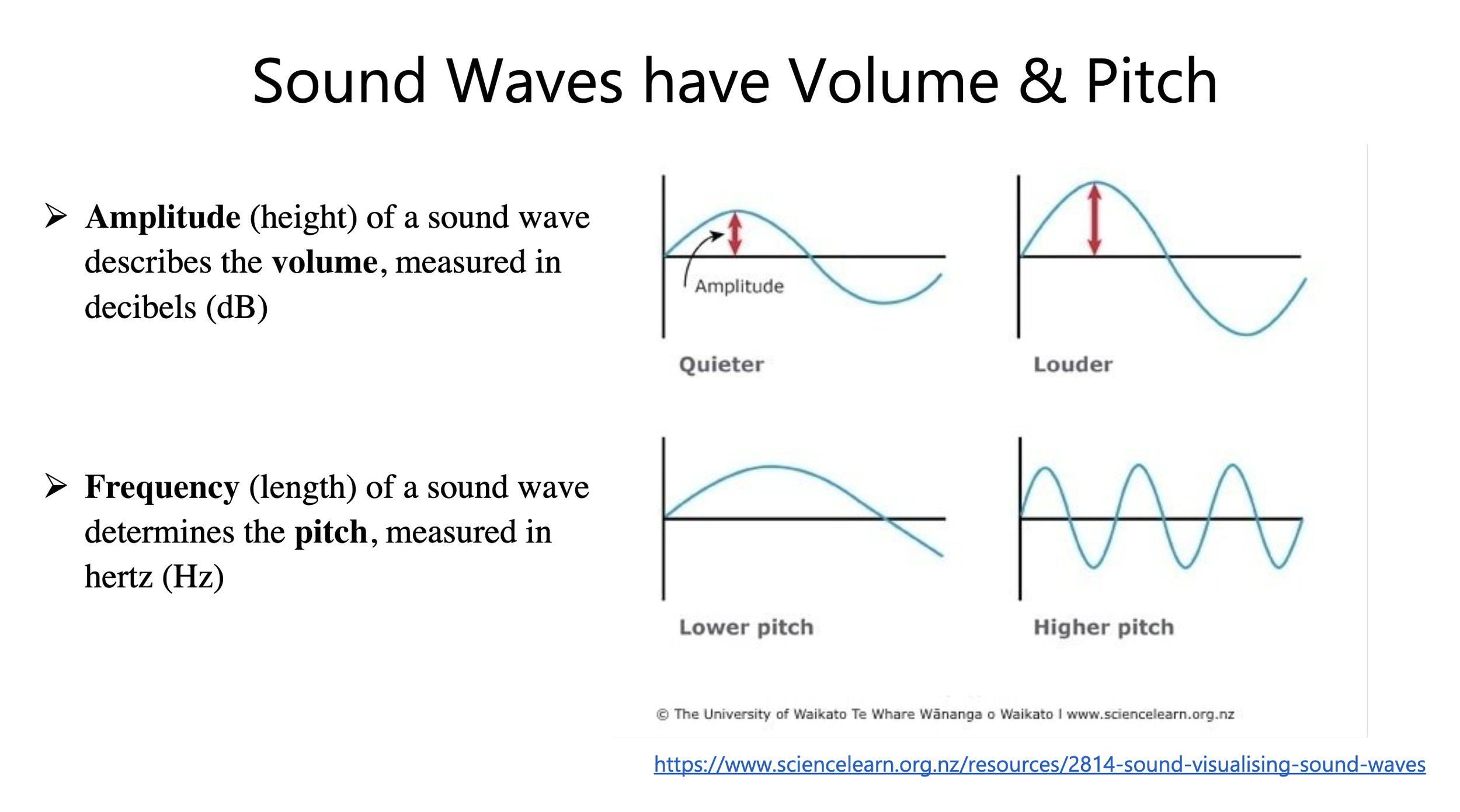
Reading a Sound Wave Graph
Sound waves are often shown as graphs of pressure vs. time.
Understanding these graphs helps explain pitch, volume, and tone quality.
Axes of a Sound Wave Graph
- Horizontal axis (time): how quickly the pressure wave repeats
- Vertical axis (pressure): how much the air pressure changes above and below normal atmospheric pressure
Pitch (Frequency)
- Pitch is determined by how often the wave repeats.
- Closely spaced waves = high frequency = higher pitch
- Widely spaced waves = low frequency = lower pitch
On the graph, this appears as:
- shorter distance between peaks -> higher pitch
- longer distance between peaks -> lower pitch
Volume (Amplitude)
- Volume (loudness) is determined by amplitude, or how tall the wave is.
- Larger pressure changes = louder sound
- Smaller pressure changes = softer sound
On the graph:
- taller peaks and deeper valleys -> louder
- shorter peaks and shallower valleys -> softer
Important: increasing volume changes height, not spacing.
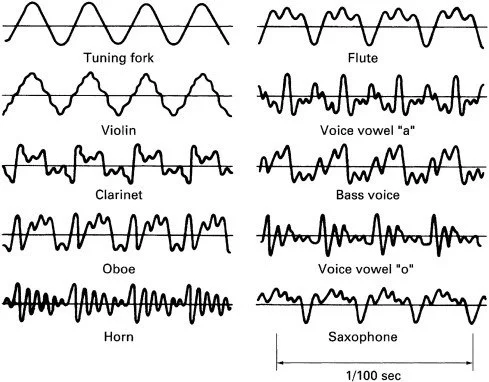
Tone Quality (Wave Shape)
- Real musical sounds are not perfect sine waves.
- The overall shape of the wave reflects the harmonic content (including the overtones) of the sound.
The instrument’s material, bore shape, tone holes, and the player’s embouchure all influence this wave shape.
Why This Matters for Players
When you change:
- air speed
- embouchure shape
You are changing the frequency, amplitude, or shape of the pressure wave — even if the fingerings stay the same.
How sound waves are activated
The player activates the sound wave by:
- vibrating a reed (clarinet, saxophone, oboe, bassoon), or
- vibrating the air at a blow-hole (flute), or
- vibrating the lips in a mouthpiece (brass).
This vibration creates a pressure pulse that compresses the air in front of it, sending the wave down the tube. The wave reflects back and interacts with the player, creating a feedback loop.
Collaboration Between Player and Instrument
When a wind instrument is played, the sound waves inside the instrument collaborate with the player.
The resulting sound depends on many factors, including:
- tube length and shape,
- whether the tube is open or closed at its ends,
- instrument material,
- tone-hole placement,
- and the player’s body (embouchure, oral cavity, air control).
The instrument does not simply amplify the player — it actively shapes and stabilizes the sound.
Standing Waves
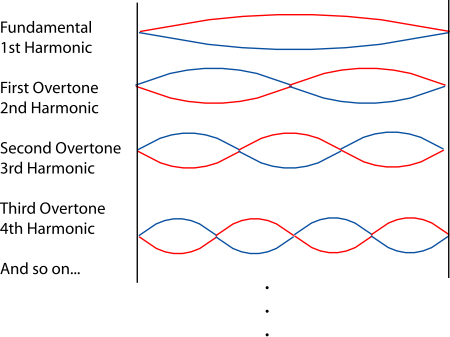
You can think of a wind instrument as a container designed to “trap” the pressure waves. And the player and instrument work together to assure that the reflected pressure waves reinforce the directed wave (instead of interfering), creating an orderly sound that is heard as a tone (instead of just noise). This reinforced wave is called a standing wave. The container for a wind instrument is a tube of specific length, adjusted precisely by the instrument maker and the player, via tone holes, valves, etc.
For a given length of tubing, there are specific standing waves that fit! These create a pattern of overtones (harmonics). The longest wave that fits is called the “fundamental” or “first harmonic”, the next longest is called the 2nd harmonic and the following one is the 3rd harmonic, etc. This pattern creates the “harmonic series” for the length of tube. The player can choose which note within the harmonic series is sounded by adjusting the air flow.
A note will sound most resonant and stable if the pressure waves reflecting back from the bell is in phase with the driving pressure at the lips/reed/hole.
More on Sound Waves
At 1:05 in this video, there’s a nice representation of a sound wave.
Think of the black dots in the animation as air molecules. When a sound wave travels, each individual air molecule stays roughly in place. It just moves back and forth a tiny amount around that same location. That red line on the left end could be the membrane of a speaker, or buzzing lips moving quickly back and forth.
Learning Check
1. Which statement best describes sound production in woodwind instruments?
2. What role does the player play in creating sound?
3. What attribute does the height of the sound wave represent?