7.5 Safety in the Studio
I have come to a frightening conclusion. I am the decisive element in the classroom. As a teacher I possess tremendous power to make a child's life miserable or joyous. I can be a tool of torture or an instrument of inspiration. I can humiliate or humor, hurt or heal. In all situations, it is my response that decides whether a crisis will be escalated or de-escalated, and a child humanized or de-humanized. It is my personal approach that creates the climate. It is my daily mood that makes the weather.
— Haim Ginott
Teaching wind and brass instruments involves working closely with the body — the breath, the embouchure, the hands, the posture, the shoulders. Sometimes the most efficient way to help a student feel what you mean is to show them through touch. But touch also carries meaning beyond the lesson: it can be comforting, corrective, surprising, or unwelcome depending on the student, the context, and the history each person brings into the room. Our goal as teachers is to use touch when it genuinely serves the student's learning, to communicate clearly about it, and to preserve the student's full freedom to say no.
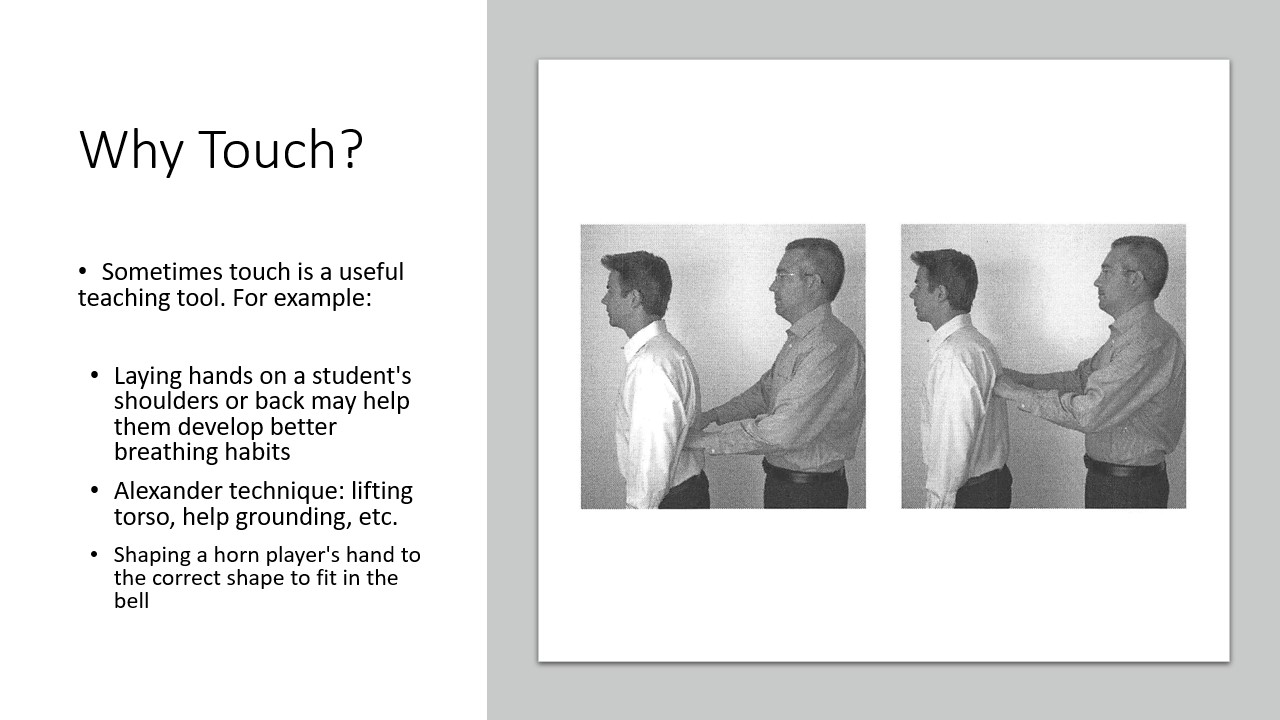
When Touch Is Useful
Physical contact can be a powerful teaching tool when words alone would be slower or less precise. Common examples in wind and brass teaching include:
- Placing a hand lightly on a student's back or side ribs to help them feel where their breath is (and isn't) expanding.
- Alexander-inspired touch to encourage the torso to lift, to ground the feet, or to release tension in the neck and jaw.
- Shaping a French horn player's right hand to the correct cupped position inside the bell.
- Guiding a trombonist's shoulder or elbow to help them feel a freer arm motion on the slide.
In each of these cases, touch is doing something words would struggle to do: bringing awareness to a specific part of the body, providing immediate sensory feedback, or letting the student feel a shape or motion they've never experienced before.
The Principle of Consent
The most important thing to understand about pedagogical touch is that consent must be continuous, specific, and genuinely given. Thuma and Miranda (2020) use the mnemonic FRIES, adapted from Planned Parenthood: consent is Freely given, Revocable, Informed, Enthusiastic, and Specific. In a teaching context, this means the student should never feel pressured to comply, should be able to say no at any moment without penalty, should know exactly what you're going to do and why, should actually want the touch (not just tolerate it), and should understand what specific part of the body you're addressing.
This matters especially in the teacher-student relationship because of the power dynamics at play. Students may comply with a teacher's touch not because they actually consent, but because they feel obligated — due to the teacher's authority, the cost of the lesson, a desire to seem professional, or an assumption that this is "just how it's done." Compliance is not consent. As a teacher, your job is to create conditions where a real "no" is possible.
Basic Guidelines
A few practical principles turn the idea of consent into everyday practice:
- Name the location and reason. Say exactly where on the body you want to touch and why. "I'd like to place my fingers on your lower back ribs so you can feel them expand on the inhale — is that okay?" is worlds different from reaching out wordlessly.
- Relate every touch to the pedagogical topic. Touch that's clearly in service of what you're working on (breath, posture, hand position) is easy to understand. Random or unrelated touch is not.
- Narrate as you go. Walk the student through the demonstration step by step. "I'm going to lift slightly here... now release... feel what happens to your breath." Speaking aloud removes ambiguity and gives the student continuous opportunity to pause you.
- When words will do, use words. Touch is one tool among many. If a verbal cue, a demonstration on your own body, a mirror, or a piece of imagery can accomplish the same thing, choose the less intimate option first.
A useful adjacent framework from Intimacy Directors International (via Thuma and Miranda) is the Five Cs: Context (the student understands why), Consent (negotiated with FRIES qualities), Communication (ongoing dialogue, not one-time permission), Choreography (clear expectation of where and when hands will be placed), and Closure (time to reflect and ask questions).
Scenarios
The following scenarios illustrate these principles in common wind and brass teaching situations.
Scenario 1: Breathing with a flute student
Unsafe Approach
The teacher walks behind the student mid-phrase and places both hands on the student's lower back, saying, "Breathe into here." The student freezes, breath catches, and they play the next phrase feeling self-conscious and watched. They never tell the teacher how uncomfortable they were.
Safer Approach
Before touching anything, the teacher says, "I want to help you feel where your breath is going. Would it be okay if I placed my fingertips on your lower back ribs for a moment, so you can feel them expand on the inhale? You can say no, or ask me to use words instead." The student agrees. The teacher narrates: "Okay, fingertips just here, and I'll keep them still while you breathe in... now notice if the ribs move out into my hands." Afterward, the teacher asks, "Did that help? Would you like to try it again, or should we work on it a different way?"
Scenario 2: Right hand position for a French horn student
Unsafe Approach
The teacher reaches into the bell and rearranges the student's fingers with a quick, "Here, like this." The student pulls back slightly, not sure what just happened, and when the teacher asks them to try again, their hand returns to its original position because they didn't actually feel what changed.
Safer Approach
The teacher says, "Your hand shape in the bell is affecting your tone. I could describe it, or I could show you on my own hand, or — if you're comfortable — I could shape your fingers directly for a moment. Which would you prefer?" If the student chooses direct shaping, the teacher narrates: "I'm going to cup your fingers together here, and curve the knuckles in slightly — feel the difference in how full your palm feels? Now play and notice the tone." If the student prefers demonstration, the teacher shapes their own hand instead. Either way, the pedagogical goal is met.
Scenario 3: Posture and alignment with a trombone student
Unsafe Approach
The teacher places both hands on the student's shoulders from behind and pushes down, saying, "Relax." The student, startled, doesn't relax — and also doesn't know how to ask the teacher to stop.
Safer Approach
The teacher says, "I notice your shoulders rising when you inhale. A lot of brass players carry tension there. Would it help if I talked you through a release, or if I placed a light hand on one shoulder to give you a point of reference? Either is fine." If the student chooses touch, the teacher places one hand gently on the top of one shoulder and says, "I'm just resting my hand here — not pressing. Take a breath and notice whether my hand goes up with you. It might, and that's good information." Awareness, not force.
Scenario 4: Embouchure with a trumpet student
Unsafe Approach
The teacher reaches toward the student's face to adjust their lips or jaw.
Safer Approach
The teacher doesn't touch the student's face at all. The embouchure is one of the most sensitive areas of the body, and verbal instruction, mirror work, and demonstration on the teacher's own face are almost always sufficient. "When words can be used just as well, use words" applies especially strongly here. The teacher says, "Notice the feeling of your upper and lower lip meeting — like saying the letter M. Watch me in the mirror." Hands off, learning intact.
Creating a Culture of Consent
Beyond individual moments, a safe studio is built by the overall culture the teacher establishes. This includes stating your approach to touch on the first day of lessons, inviting the student to tell you if anything ever feels wrong, checking in periodically (not just at the start), and treating a "no" with matter-of-fact respect rather than disappointment. Students should feel that declining a touch — or asking you to stop mid-demonstration — is as routine as asking you to repeat an instruction.
Power asymmetry between teacher and student never fully disappears, but naming it and working to balance it goes a long way. Practices like offering choices ("touch or words?"), checking in afterward ("did that help?"), and modeling your own willingness to be corrected all signal that the student's autonomy matters. Touch, when used this way, becomes one more way of communicating care — not an exercise of authority over the student's body.
Reading: Hands On, Hands Off — Pedagogical Touch in the MeToo Era
Next Class Preparation
Be prepared to participate in break-out discussions on pedagogical touch.