7.2 Teaching Musicianship
The Big Idea
Musicianship is teachable. Some students arrive with more intuitive expression than others, but phrasing, inflection, and shape can be learned — just as a second language can be learned deeply enough to express nuance and feeling.
One way to encourage students to experiment with inflection and musical storytelling is to have them play the same melody with different expressive goals in mind. For example, you can use an Emotions Wheel like the one below: have the student spin the wheel, then play a specific musical phrase in a way that expresses the emotion it lands on.
In the book From the Stage to the Studio, Watkins and Scott define musicianship as the unification of technical skill with expressive meaning: the place where the instrument disappears and the listener hears only the music. This page offers concrete methods for teaching that integration — drawing on Marcel Tabuteau’s numbering systems — alongside the broader sensory and contextual inroads Watkins and Scott describe.
Why Inflection Matters
Consider a simple sentence: My name is Hazel.
Depending on which word you emphasize, it means four completely different things:
- MY name is Hazel — not yours, mine.
- My NAME is Hazel — not my nickname.
- My name IS Hazel — despite what you think.
- My name is HAZEL — specifically Hazel, not Heather.
Same words. Different inflection. Different meaning.
Musical phrases work the same way. A sequence of notes played in a flat monotone is technically accurate but says nothing. The musician’s job is to decide which notes carry weight, which yield, which lead, and which arrive.
Marcel Tabuteau’s Numbering Systems
Marcel Tabuteau (1887–1966) was principal oboist of the Philadelphia Orchestra for nearly four decades and a legendary teacher at the Curtis Institute. His students — John de Lancie, John Mack, Joseph Robinson, Laila Storch, Marc Lifschey, and many others — carried his approach into nearly every major American orchestra and conservatory, making his influence on American wind playing difficult to overstate. Tabuteau was famous for his use of numbers to describe musical shape and motion, applying them in many different ways over the course of his teaching. What follows are two of those systems: one for the weight of each note, and one for the forward motion from one note to the next. They address different aspects of phrasing, and they work together.
System 1: Numbering for Intensity
The Idea
Not every note is equal. Some are peaks, some are passing motion, some are preparation.
Tabuteau asked students to number each note on a scale of relative intensity — often 1 to 5. A rising phrase might go 1 → 2 → 3 → 4 → 5 → 4 → 3 → 2, with the peak on the 5 and resolution at the end.
Numbers Aren’t Dynamics
A 5 is not simply “louder” than a 1. It may carry more rhythmic weight, more color or vibrato intensity, or more of what Tabuteau called “life.” The numbers represent the role of each note in the shape of the phrase — part of what he called the scale of nuance. Most students use only two or three points on that scale; the mature player has access to dozens.
Try It: Mozart Horn Concerto No. 3, 2nd Mvt. (K. 447)
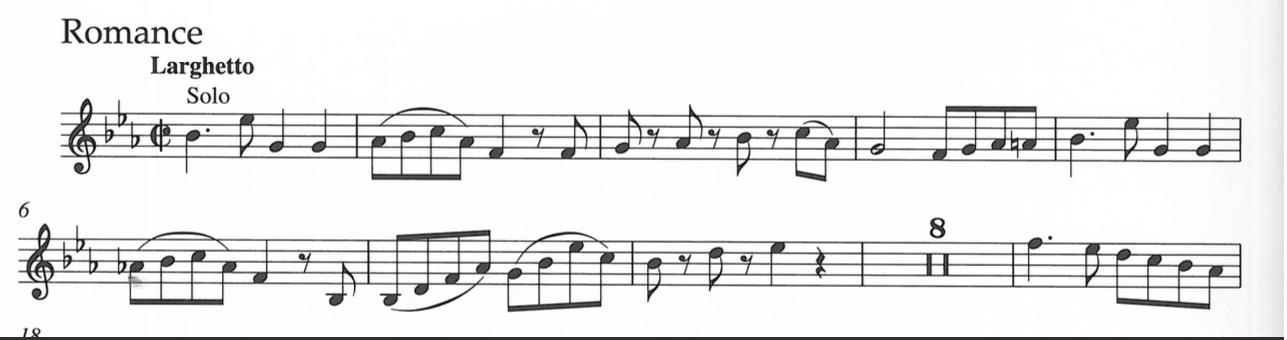
The opening phrase is a simple ascending line resolving into a lyrical melody. A student may play it with correct rhythm, clean slurs, even tone — and still sound flat.
Toolbox Assignment:
- Assign numbers to each note. Where is the peak? What’s passing motion? What’s preparation?
- Sing the numbers out loud — not the pitches. Feel the shape.
- Play the phrase again with those numbers in mind.
- Upload a picture of your numbered melody to your toolbox.
Even though the notes didn’t change and the intonation didn’t change, the phrase is now shaped and much more impactful.
System 2: Numbering for Note Grouping
The Problem with the Page
Modern notation beams notes according to the beat — useful for ensemble rhythm, but misleading for phrasing. Music doesn’t move in discrete beat-blocks. It moves in a continuous pull from upbeat to downbeat.
Counted the usual way — “1-2-3-4 | 1-2-3-4” — each group’s energy diminishes and the next downbeat lands with a fresh, punchy accent.
Tabuteau’s Fix: Re-Count the Subdivisions
Instead of “1-2-3-4 | 1-2-3-4,” count: “1 | 2-3-4-1 | 2-3-4-1”
The opening “1” is a starting point. Every group after that leads forward to the next downbeat. The downbeat is prepared, not hammered.
A Note on Terminology
In this system, upbeat and downbeat don’t refer to metrical position. They refer to function — whether a note leads (upbeat) or arrives (downbeat).
Deep Roots: Arsis and Thesis
Tabuteau drew on the ancient Greek concepts of arsis (raising — the lift of the foot) and thesis (lowering — the foot coming down). Music, like walking or breathing, moves in a natural cycle of rise and settle.
Try It: Haydn Symphony No. 31, Mvt. 4 (Horn 2)
In the following excerpt from his dissertation, Josh Michal demonstrates this with the Horn 2 part of the final movement:
| Counted as written | Re-counted for motion |
|---|---|
| 1-2-3-4 | 1-2-3-4 | 1 | 2-3-4-1 | 2-3-4-1 |
| Punchy, accented downbeats | Prepared, flowing downbeats |
| Groups feel self-contained | Groups pull forward |
The notes on the page haven’t changed. The student’s relationship to them has.
Zooming Out: Motivic Grouping
The same principle — looking past the visual layout of the page to find the true grouping — applies at a larger scale, across bar lines. A motif is a short rhythmic or melodic idea that repeats throughout a work. Just as beat-level beaming can obscure note grouping, bar lines can obscure motivic grouping.
Case Study: Wagner’s “Ride of the Valkyries”
The famous opening motif from Wagner’s Die Walküre is almost universally played with a breath on each bar line and a crescendo to beat 2 within each bar. Elmer Fudd’s “Kill da wabbit” in the Warner Bros. cartoon What’s Opera, Doc? reinforces that tradition. But is this how Wagner intended the motif to be shaped?
Wagner himself provides the answer. The one place in the entire Ring cycle where he sets this melody to words is Siegrune’s line later in Act 3: “In brünstigem Ritt jagt Brünnhilde hier!” (“In feverish ride flies Brünnhilde here!”). The German syntax groups the motif across the bar line — pickup → arrival → resolution — not bar-by-bar. The motif as Wagner set it is a single gesture that crosses the bar line; the traditional bar-line breathing and accent on beat 2 actually break it.
Brass players in particular should consider whether the traditional phrasing reflects the composer’s intent or merely a performance habit that has become received wisdom.
Tradition, the beaming system, and bar lines all impose visual groupings that may not match the musical grouping. Students should be trained to ask: does what I’m seeing on the page match what the music is actually doing? Often, it doesn’t.
Putting It Together
These tools do different jobs:
- Note grouping gives the phrase direction — every note knows where it’s going.
- Intensity scaling gives the phrase architecture — not every note carries equal weight.
- Motivic grouping ensures that larger gestures are read correctly, not obscured by bar lines or tradition.
Used together, they give the student both the shape and the momentum of the music.
What This Replaces
Instead of vague feedback like “play more musically,” the teacher can now say:
- “Count this group as leading to the downbeat.”
- “This note is a 3, not a 5.”
- “That motif should cross the bar line — breathe here instead.”
The work of phrasing becomes as specific and rigorous as the work of technique.
What This Doesn’t Replace
Numbers and groupings are tools, not substitutes for imagination. The sensory images, human experiences, and historical context Watkins and Scott describe remain the source of expressive playing. Tabuteau’s systems are the mechanism for translating that imagination into audible phrasing.
Key Takeaways
- Inflection changes meaning — in speech and in music.
- Tabuteau’s intensity scale (1–5) assigns weight to each note.
- Tabuteau’s note grouping (1 | 2-3-4-1 | 2-3-4-1) creates forward motion.
- Motivic grouping can cross bar lines — Wagner’s “Ride of the Valkyries” is a famous example.
- These are only some of the ways Tabuteau used numbers to teach musicianship.
- All three turn vague advice into specific, teachable direction.
- They support the broader goals of musicianship — context, sensory imagination, expression — rather than replacing them.